The Indian family dinner, region by region
Weeknight dinners from 8 Indian regions, read against the national dietary guidelines, with small changes that keep every dish.
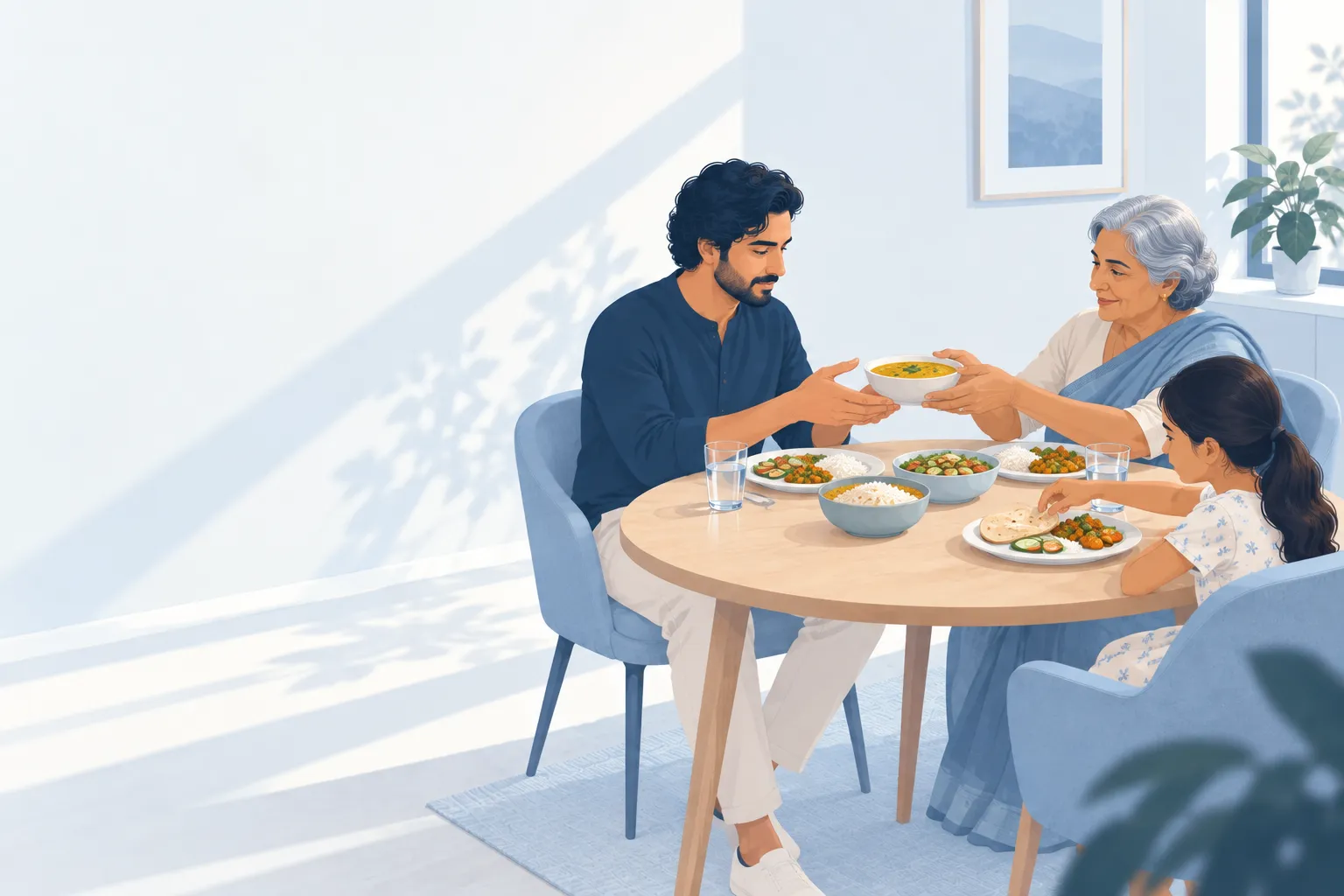
The rice or the rotis go round, someone ladles the dal, and a grandparent tells the story everyone has heard before. In many homes, dinner is the one meal everyone sits down to together, and when someone at the table starts working on their weight, it is often the meal they worry about losing.
This series keeps it. We picked 8 regions and 1 ordinary weeknight dinner from each, the food on the table on a Tuesday rather than at a wedding. For each one we look at what it does well and which small changes help someone managing their weight, without taking a dish off the table.
Find your dinner
- Punjab: dal, aloo-gobhi, raita and rotis, with the roti basket, the butter dish and the pickle jar to watch.
- Gujarat: khichdi, kadhi and bajra rotla with a steel tumbler of chaas.
- Maharashtra: varan-bhaat, bhakri, pithla and a sprouted usal, and the line of ghee on top.
- Bengal: rice, masoor dal, a light fish jhol, shukto and begun bhaja.
- Tamil Nadu: rice under sambar, rasam and curd, with poriyal and kootu alongside.
- Kerala: matta rice, fish curry from the chatti, thoran, avial and moru.
- Telangana: rice, tomato pappu, a home-style chicken curry and gongura pachadi.
- Assam: rice, masor tenga, aloo pitika and a dish of greens.
Each post also builds 1 plate for the person managing their weight from the same pots as everyone else's, and looks at the family around the table: who cooks, and who may have their own doctor's targets.
The yardstick
Every post reads its dinner against the Dietary Guidelines for Indians published by ICMR's National Institute of Nutrition in 2024. Its "My Plate for the Day" gives vegetables, fruits and greens roughly half the plate. Cereals and millets take most of the rest, followed by pulses, eggs and flesh foods, nuts and seeds, and milk or curd.[1]
The plate counts roots and tubers in that vegetable half, while the 2,000 kcal model diet behind it leaves potato out of its vegetable amount.[1] So where potato is on the table, it stays, and the other vegetables do most of the filling.
A few of its numbers come up again and again:
- Cereals: no more than 45% of the day's energy from cereals and millets.[1]
- Cooking oil: about 20 g of visible fat a day for a sedentary woman and 30 g for a sedentary man, with ghee or butter kept to 1 to 2 teaspoons a day.[1]
- Salt: no more than 5 g a day, about 1 teaspoon, with papads, pickles and namkeen named among the foods that push it up.[1]
- Added sugar: more than 25 g a day counts as high, and jaggery and honey count as added sugar.[1]
- Protein: eating cereals and pulses together, about 3 parts to 1 by raw weight, improves the quality of the protein in the meal.[1]
These are population guidelines for healthy adults, built around a 2,000 kcal reference day. We use them to read a dinner, not to prescribe one.
Another number comes from the Indian Food Composition Tables: fat carries 9 kcal a gram, which puts a 5 g teaspoon of ghee or oil at about 45 kcal.[3] That is why several posts measure the ghee and oil by the spoon.
More grain, less dal
The same guidelines put the cereal share of Indian diets at 50% to 70% of the day's energy, above the ceiling in the list.[1] The staple supplies more of the day's energy than the guideline allows.
Pulses and flesh foods run the other way. NIN reports that pulses, meat, poultry and fish together give Indian diets 6% to 9% of their energy, against the 14% it recommends.[1]
The ICMR-INDIAB survey, which asked adults across India what they ate between 2008 and 2020, found protein supplied about 12% of daily energy; the survey's authors set that against a 15% figure.[2] So most changes in this series pair a smaller helping of rice or roti with a larger one of something already on the table: a second katori (small bowl) of dal, another piece of fish, a bigger bowl of the vegetable.
If anyone at the table has diabetes, high blood pressure or kidney disease, their own doctor or dietitian may set different targets from the general guidelines here. Anyone who takes medicine for diabetes should check with their doctor before eating less rice or roti at dinner.
Changing which grain you eat is a separate question. In the same survey's modelling, replacing 50 g of refined cereal with 50 g of whole wheat or millet flour, without eating less carbohydrate overall, was not linked to lower odds of abdominal obesity, fat carried around the waist. The survey measured people once, so this is an association.[2] The posts that follow change how much grain goes on the plate more than which grain it is.
At every one of these tables, the rice or the rotis still go round, and the grandparent still tells the story everyone has heard before.
How we wrote this
Every nutrition claim cites its source: the ICMR-NIN dietary guidelines, the Indian Food Composition Tables, the ICMR-INDIAB survey, NFHS-5 and National Sample Survey reports. Where no source covered a point, we left it out or described it only as common in many homes. The family photographs are AI-generated, and the people in them are illustrative, not patients.
To have a doctor look at the whole picture, including what your own table looks like, you can book a consultation.
No. The national dietary guidelines limit cereals to a share of the day's energy; they do not remove them. Every post in this series keeps the rice or roti on the plate, in a smaller helping, with more of the dal, fish or vegetables beside it. Anyone who takes medicine for diabetes should check with their doctor before eating less rice or roti at dinner.
Yes. The plate for the person managing their weight uses the same dishes in different proportions. If someone at the table has diabetes, high blood pressure or kidney disease, their own doctor or dietitian may set different targets.
The KiloCare editorial team checked each figure against the Indian government or ICMR source it cites, down to the page or table.
Sources
- ICMR-NIN Expert Committee. Dietary Guidelines for Indians - 2024. Hyderabad: ICMR-National Institute of Nutrition; 2024. Available from: nin.res.inCited atp. ivp. 6; Table 1.2a, p. 7p. 5p. 54pp. 74, 94p. 94p. 58p. ivp. iv
- Anjana RM, Sudha V, Abirami K, Gayathri R, Manasa VS, et al. Dietary profiles and associated metabolic risk factors in India from the ICMR-INDIAB survey-21. Nat Med. 2025;31(11):3813-24. doi:10.1038/s41591-025-03949-4. PMID: 41028544. Available from: nature.comCited atExtended Data Table 2Extended Data Table 7
- Longvah T, Ananthan R, Bhaskarachary K, Venkaiah K. Indian Food Composition Tables 2017. Hyderabad: National Institute of Nutrition, Indian Council of Medical Research; 2017. Available from: nin.res.inCited atTable 4, p. xxi