A Kerala dinner around the fish curry chatti
Fish curry from the clay chatti with red matta rice, thoran, avial and moru, and a way to keep the coconut in every dish while measuring it.
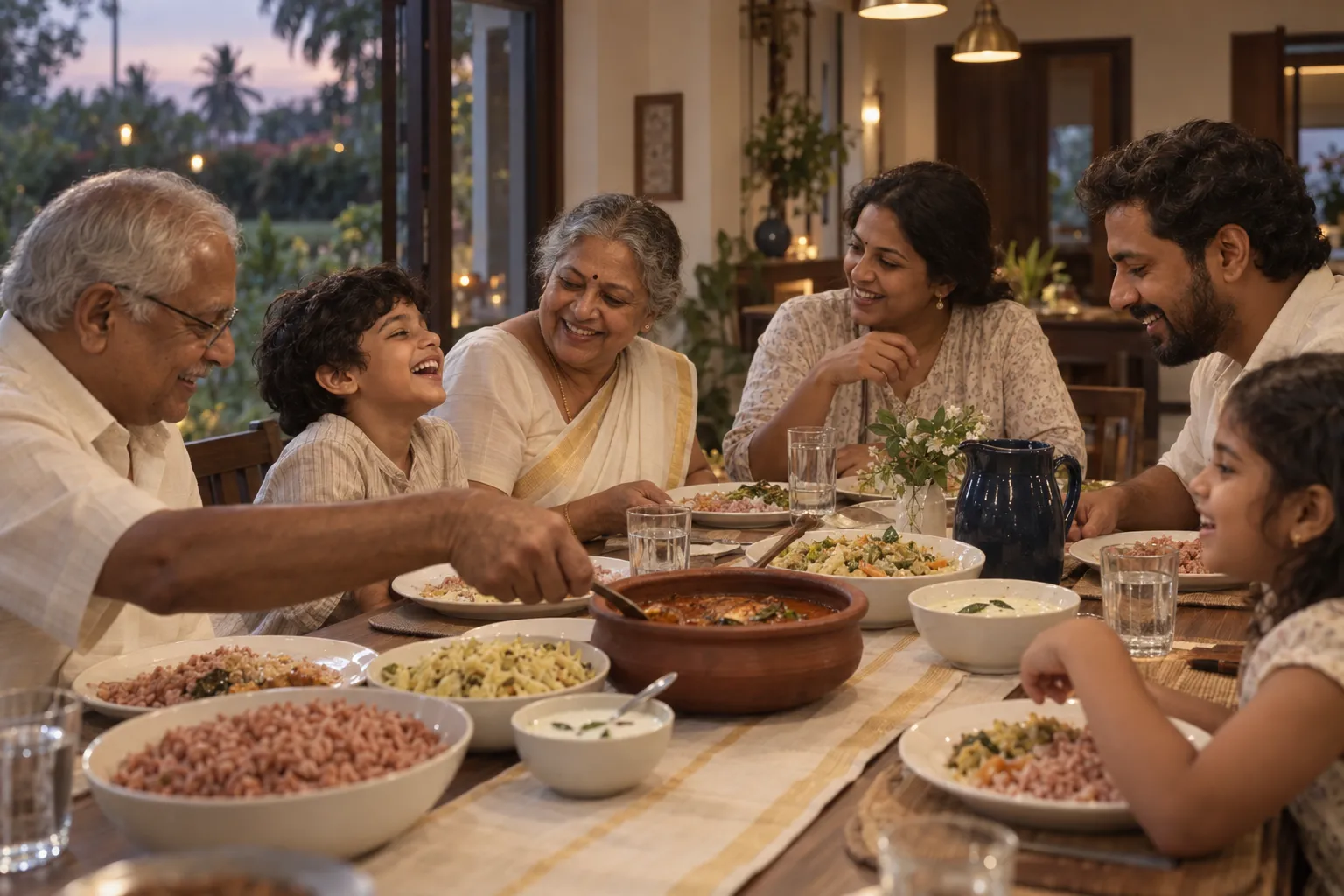
The fish curry arrives in the clay chatti it was cooked in, still too hot to hold without a cloth. Beside it are red matta rice, cabbage thoran (vegetables stir-fried with grated coconut), a bowl of avial (mixed vegetables in coconut and curd) and moru, a spiced buttermilk, to pour over the last of the rice or into a tumbler. The grandchildren have already picked out the pieces of fish they want, and their grandparents are letting them.
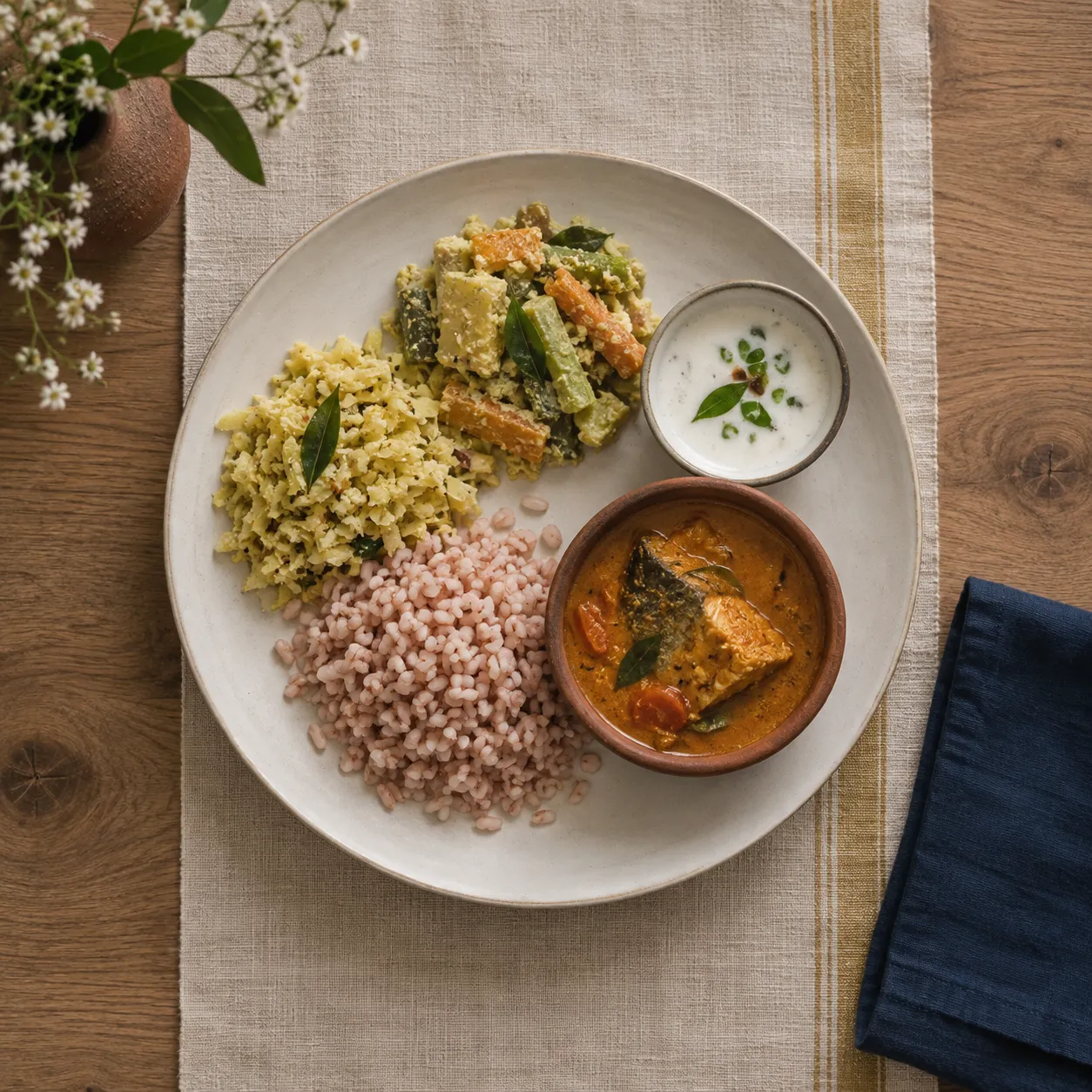
- Avial vegetables in coconut and curd
- Cabbage thoran stir-fried with grated coconut
- Matta rice red rice
- Moru spiced buttermilk
- Fish curry from the clay chatti
| Per 100 g raw | Energykcal | Proteing | Carbsg | Fatg | Fibreg |
|---|---|---|---|---|---|
| Indian mackerel | 101 | 21.5 | none | 1.5 | none |
| Coconut, fresh | 409 | 3.8 | 6.3 | 41.4 | 10.4 |
| Cabbage | 22 | 1.4 | 3.3 | 0.1 | 2.8 |
| Per 100 g raw | Ironmg | Folateµg | Zincmg | Calciummg | β-caroteneµg |
|---|---|---|---|---|---|
| Indian mackerel | 1.5 | none | 0.7 | 31 | none |
| Coconut, fresh | 1.3 | 25 | 0.6 | 8 | 3 |
| Cabbage | 0.4 | 46 | 0.2 | 52 | 20 |
Per 100 g of each raw ingredient, not a cooked helping. Bold marks the ingredient with the most of each micronutrient per 100 g raw. That is not what a served portion delivers. "none" means none is listed.
Values: Indian Food Composition Tables 2017.[3] IFCT has no row for matta rice.
The fish, the moru and the vegetables already fit India's national dietary guidelines. The amounts to watch are the rice and the coconut, and the changes below keep the coconut in the food.
The fish is the strong suit
of women aged 15 to 49 in Kerala ate fish at least once a week (NFHS-5, 2019-20).[1]
of men aged 15 to 49 in Kerala did the same.[1]
Estimates built from 2022-23 household purchases point the same way.
Against about 12% across rural India.[6]
ICMR-NIN's 2024 guidelines count fish among the flesh foods that supply good-quality protein, and suggest about 200 g of marine fish a week for its long-chain omega-3 fats. NIN's examples include mackerel.[2]
For the local fish, the Indian Food Composition Tables list the Indian mackerel (Rastrelliger kanagurta) at about 21.5 g of protein per 100 g of raw fish.[3]
Moru and 2 vegetable dishes
Moru is already the kind of drink NIN points to: its guidelines list buttermilk and lemon water as alternatives to soft drinks. They also name drinks with added salt among high-salt foods, so the salt in the moru is worth keeping light.[2]
With a thoran and an avial, vegetables get 2 dishes to themselves. NIN's model plate gives vegetables, greens, roots and fruit about half its space.[2]
The matta mound and the grater
Rice is the base of this meal, as it is across the South. In ICMR-INDIAB, white rice was the main cereal for 87% of the adults surveyed in the southern states.[4]
Whatever the colour of the rice, NIN's guidance is about how much. Cereals and millets should supply no more than 45% of the day's energy.[2]
With no dal on the table, the protein here comes from the fish. In ICMR-INDIAB, whose Kerala fieldwork ran in 2018-19, protein supplied 10.5% of the day's energy, against the 15% figure the survey's authors used.
Share of the day's energy from protein, adults in Kerala (ICMR-INDIAB, fieldwork 2018-19). The 15% is the figure the survey's authors set it against.[4]
Coconut runs through the meal. In National Sample Survey data from 2011-12, coconut oil was the main cooking oil in Kerala: in rural homes, about 450 g of the roughly 550 g of cooking oil per person, per 30 days, in household consumption.[5]
Grated coconut often goes into the thoran and the avial too. The Indian Food Composition Tables list fresh coconut kernel at about 41 g of fat per 100 g.[3]
NIN groups coconut oil with ghee, butter and palm oil as saturated fats.[2]
In NFHS-5, 62% of women aged 15 to 49 in Kerala ate dark green leafy vegetables at least once a week.[1] The thoran pan is an easy place for more of them.
1 teaspoon is a level teaspoon, not heaped: about 5 g of oil, ghee or salt.
NIN's figures for sedentary adults, for the whole day. It counts 20 to 50 g of cooking fat as 4 to 10 teaspoons, and 5 g of salt as 1 teaspoon.[2]
Coconut, fish and the thoran pan
- Grate the coconut once, for both dishes. Measure out the grated coconut for the thoran and the avial together, a little less than usual, and let the vegetables fill the pan. The oil goes into the chatti from a measuring spoon. The tempering, the curry and the coconut flavour are all still there.
- Cherupayar or parippu on non-fish nights. A curry of cherupayar (whole green gram) or parippu (dal) takes the place of a scoop of rice; the thoran and moru stay as they are. Raw whole green gram has about 22.5 g of protein per 100 g, and NIN notes that pairing cereal with pulse improves the quality of the meal's protein.[3][2]
- Put greens into the thoran rotation. Some nights the cabbage gives way to cheera (amaranth leaves) or other leafy greens, with the same tempering, the same grated coconut and the same pan. NIN's guidelines ask for green leafy vegetables in every meal.[2]
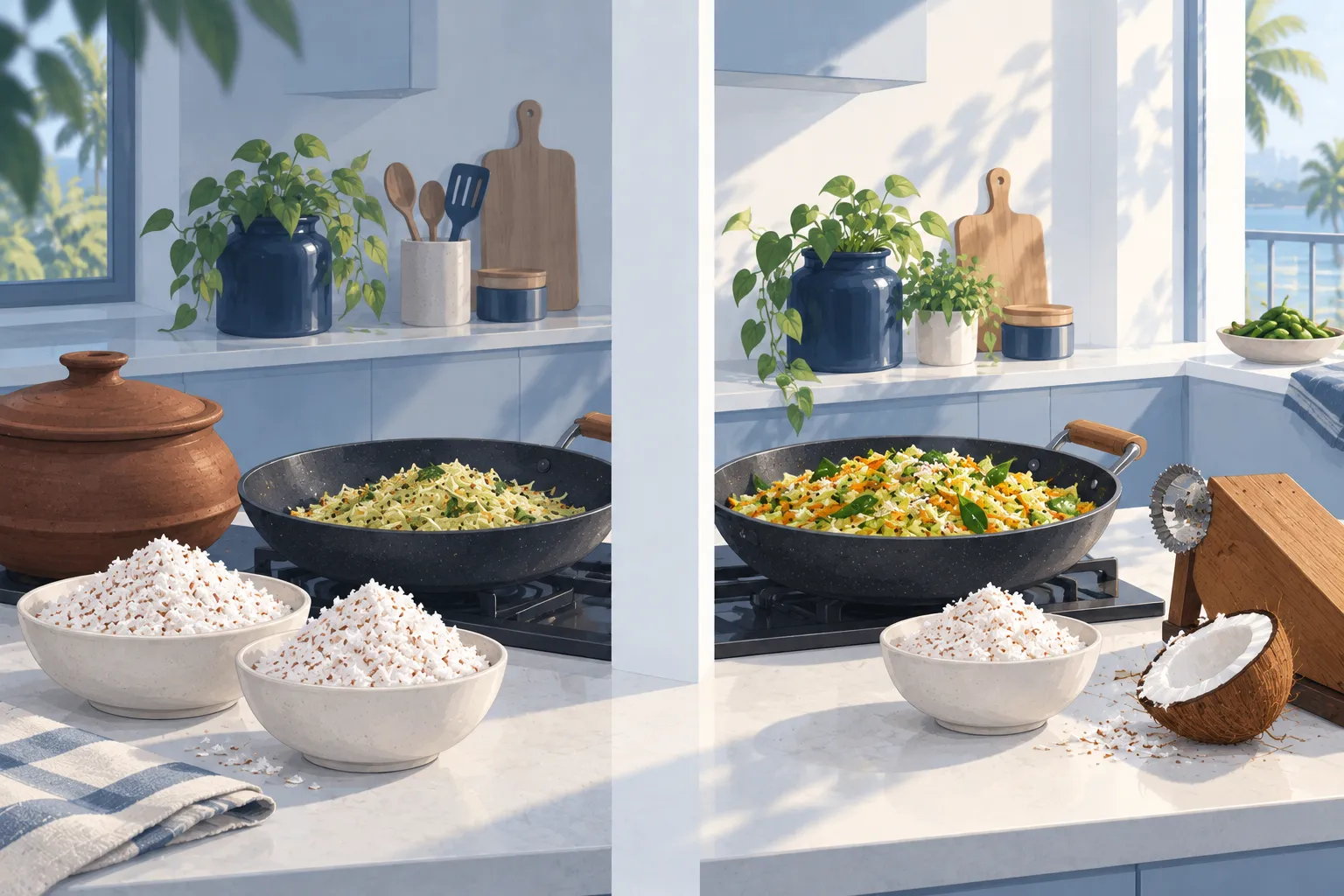
The usual wayCoconut grated generously for each dish
This wayGrated once for both dishes, a little less
How to do it
- Grate the coconut for the thoran and the avial together.
- Take a little less than usual, and let the vegetables fill the pan.
- Pour the oil into the chatti from a measuring spoon.
Fresh coconut kernel carries about 41 g of fat per 100 g.[3]
Thoran, avial and fish on one plate
Everyone eats from the same pots. Borrowing NIN's daily proportions for this 1 meal, thoran and avial take about half the plate.[2] A piece of fish goes beside them, or 2 on a night when there is plenty, with a spoon of the curry. The matta rice fills what is left, a little less than the rest of the table takes, and the moru goes over its last few mouthfuls as it always has.
- Half: thoran and avial
- Most of the rest: matta rice, a little less than the rest of the table takes
- The rest: a piece of fish, or 2, with a spoon of the curry
The cook's side of the table
These changes are small, and they all happen in the kitchen.
The chatti still comes to the table too hot to hold without a cloth. Tonight the coconut for the thoran and the avial came out of 1 bowl, and the grandchildren are still picking out their pieces of fish.
If anyone at the table has diabetes, high blood pressure or kidney disease, their own doctor or dietitian may set different targets from the general guidelines here. Anyone who takes medicine for diabetes should check with their doctor before eating less rice at dinner.
To have a doctor look at your weight alongside everything else on your plate, you can book a consultation.
No. India's dietary guidelines group coconut oil with ghee and butter as saturated fats and ask for moderation with all cooking oils. Measuring it into the pan with a spoon, instead of pouring from the bottle, is a practical way to do that.
India's food composition tables have no entry for matta rice, so we have no verified figures to compare. The change this post suggests is a smaller rice portion, whichever rice you cook.
If anyone at the table has diabetes, high blood pressure or kidney disease, their own doctor or dietitian may set different targets from the general guidelines here. Anyone who takes medicine for diabetes should check with their doctor before eating less rice at dinner.
Sources
- International Institute for Population Sciences (IIPS), ICF. National Family Health Survey (NFHS-5), 2019-21: India: Volume I. Mumbai: IIPS; 2021. Available from: dhsprogram.comCited atTable 10.27.1, p. 440Table 10.27.2, p. 441Table 10.27.1, p. 440
- ICMR-NIN Expert Committee. Dietary Guidelines for Indians - 2024. Hyderabad: ICMR-National Institute of Nutrition; 2024. Available from: nin.res.inCited atpp. 56, 59p. 94p. 6p. 5p. 52pp. 54, 74p. 58p. 1p. 6
- Longvah T, Ananthan R, Bhaskarachary K, Venkaiah K. Indian Food Composition Tables 2017. Hyderabad: National Institute of Nutrition, Indian Council of Medical Research; 2017. Available from: nin.res.inCited atTables 1, 2, 4 and 5Table 1, p. 26Table 1, p. 17Table 1, p. 4Table 1, p. 17
- Anjana RM, Sudha V, Abirami K, Gayathri R, Manasa VS, et al. Dietary profiles and associated metabolic risk factors in India from the ICMR-INDIAB survey-21. Nat Med. 2025;31(11):3813-24. doi:10.1038/s41591-025-03949-4. PMID: 41028544. Available from: nature.comCited atExtended Data Table 1Extended Data Tables 2 and 5
- National Sample Survey Office. Household Consumption of Various Goods and Services in India, 2011-12. New Delhi: Ministry of Statistics and Programme Implementation; 2014 Jun. NSS Report No. 558 (68th round). Available from: mospi.gov.inCited atAppendix A, Table 1R, p. A-54; Table 1U, p. A-246
- National Statistics Office. Nutritional Intake in India (2022-23 & 2023-24). New Delhi: Ministry of Statistics and Programme Implementation; 2025. NSS Report No. 594. Available from: mospi.gov.inCited atTable 3.10, p. 40