How a Gujarati khichdi pot can carry more dal
A Gujarati dinner of khichdi, kadhi, bajra rotla and chaas, and 3 changes in the pot for the sugar, the ghee and the papad.
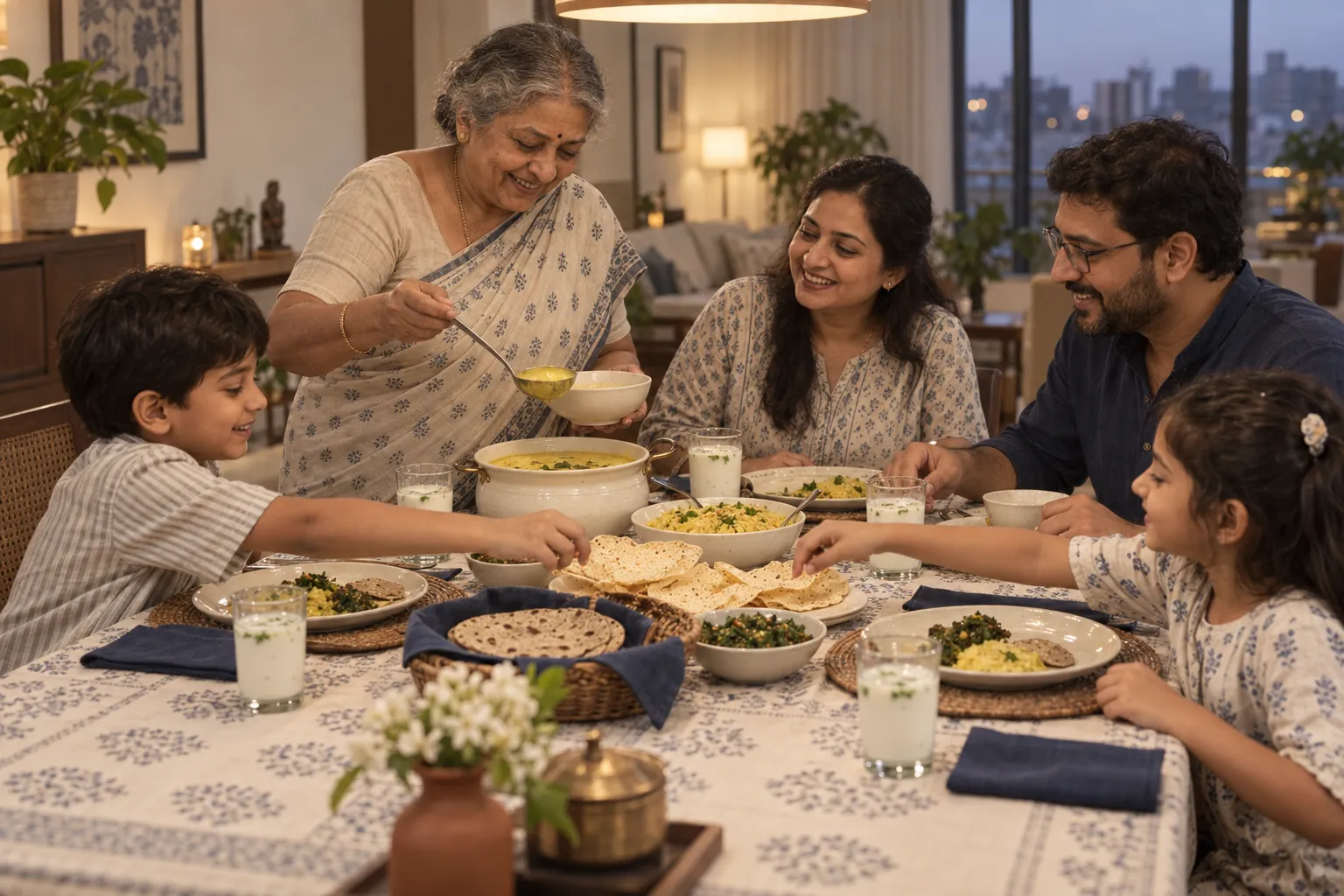
The papad goes first. The grandchildren have a piece each before the adults have pulled their chairs in, and Ba, their grandmother, is bringing the kadhi to the table, thin and pale, tempered in a small pan a minute ago. The khichdi waits in a steel pot beside a green sabzi and a short stack of thin bajra rotlas, with a steel tumbler of chaas at every place. School bags are still by the door; it is a weeknight.
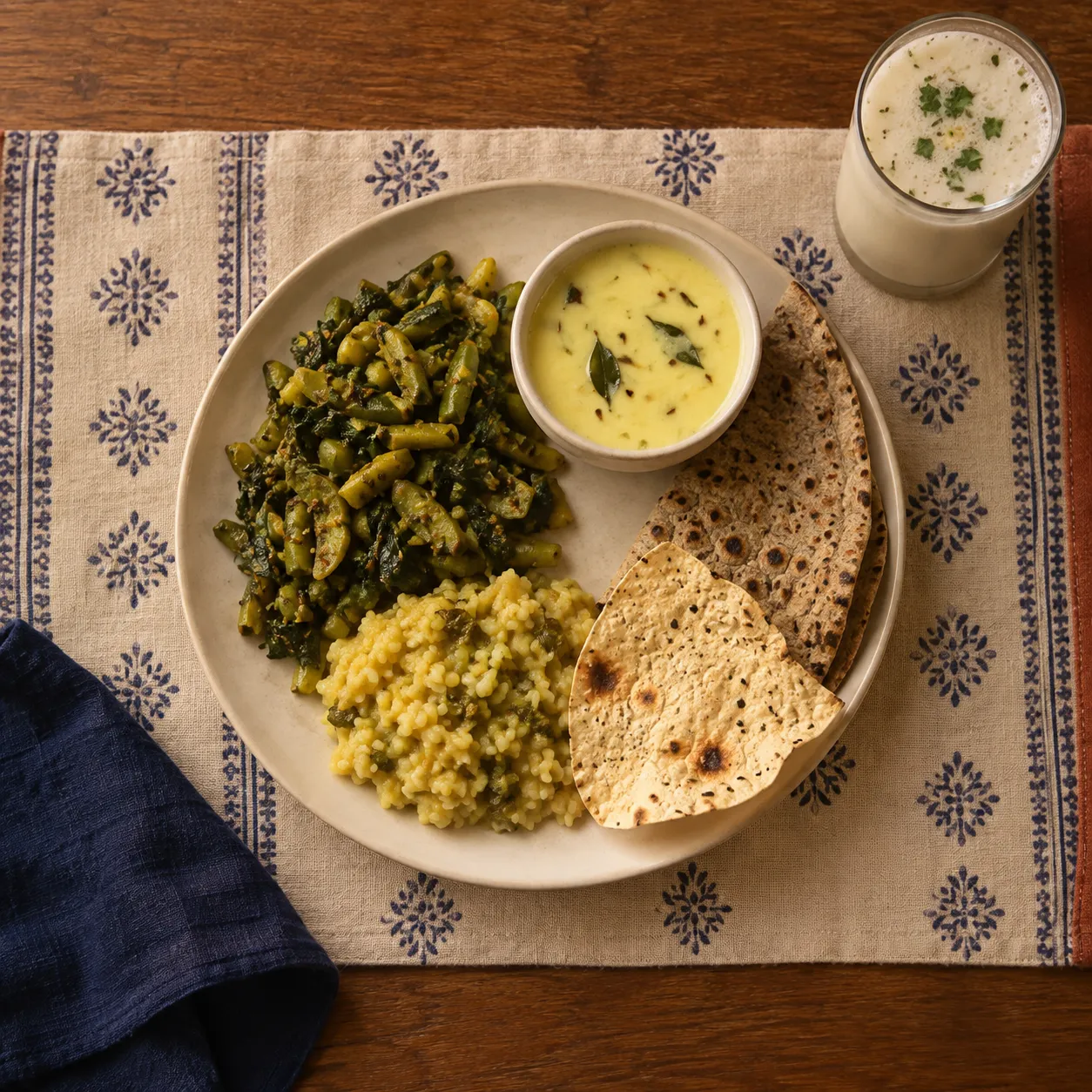
- Green sabzi
- Khichdi lentils cooked into the grain
- Chaas buttermilk to drink
- Kadhi thin and pale, just tempered
- Bajra rotla a millet flatbread
- Papad the first to go
| Per 100 g raw | Energykcal | Proteing | Carbsg | Fatg | Fibreg |
|---|---|---|---|---|---|
| Rice, milled | 356 | 7.9 | 78.2 | 0.5 | 2.8 |
| Bajra | 348 | 11.0 | 61.8 | 5.4 | 11.5 |
| Per 100 g raw | Ironmg | Folateµg | Zincmg | Calciummg | β-caroteneµg |
|---|---|---|---|---|---|
| Rice, milled | 0.7 | 9 | 1.2 | 7 | none |
| Bajra | 6.4 | 36 | 2.8 | 27 | 28 |
Per 100 g of each raw ingredient, not a cooked helping. Bold marks the ingredient with the most of each micronutrient per 100 g raw. That is not what a served portion delivers. "none" means none is listed.
Values: Indian Food Composition Tables 2017.[2] The khichdi dal, the green sabzi and the kadhi's besan are not in this table; IFCT has no besan row.
Much of this is what the dietary guidelines ask for: lentils cooked into the grain, a millet flatbread, a green vegetable and buttermilk. The rest is decided in the kitchen, in the sugar in the kadhi, the ghee on the khichdi, the oil for the papad, and rice and bajra on the same plate.
The dal, the millet, the buttermilk
Khichdi is rice and dal cooked together, the combination that the ICMR-NIN Dietary Guidelines for Indians (2024) describe as better-quality protein than either food alone.[1]
The rotla is bajra, or pearl millet, with far more fibre than the rice in the khichdi pot, as the table above shows.[2]
Millet is an everyday grain here.
2022-23 household consumption survey.[4]
Chaas is a drink NIN itself names, with lemon water, in place of soft drinks.[1] With kadhi on the same table, this is a dairy-rich dinner, and the green sabzi covers the vegetables NIN asks for at every meal.[1]
Sugar, ghee, papad, a second grain
Many Gujarati homes add a little sugar or jaggery to kadhi and dal; the sweet-sour balance is part of the recipe. NIN counts jaggery and honey as added sugar, the same as table sugar, and defines more than 25 g a day, or 5% of energy, as high.[1]
Share of the day's energy from sugar, jaggery and honey added in cooking and at the table, adults in Gujarat (ICMR-INDIAB, 2012-13).[3]
That figure covers the whole day, not only the kadhi.
Many cooks add a spoon of ghee to the khichdi, and often to the kadhi's tadka.
Papad brings salt and oil together. NIN lists papads among foods high in salt, and counts all deep-fried foods as high in fat.[1]
Then there is the second grain, bajra in the rotla beside the rice in the khichdi. ICMR-INDIAB found that adults in Gujarat drew an equal share of energy from refined cereals and from milled whole grains.[3] Both count towards NIN's ceiling of 45% of the day's energy from cereals and millets.[1]
In estimates built from 2022-23 household purchases, pulses supplied about 11% of the protein in rural Gujarat.[5] More dal in the khichdi pot raises it.
1 teaspoon is a level teaspoon, not heaped: about 5 g of oil, ghee or salt.
NIN's figures for sedentary adults, for the whole day. It counts 20 to 50 g of cooking fat as 4 to 10 teaspoons, and 5 g of salt as 1 teaspoon.[1]
3 changes that start in the pot
- More dal in the khichdi pot. Put a little more dal and a little less rice into the pot, so every ladle carries more lentils. The khichdi stays soft and still takes its kadhi.
- Half the sugar in the kadhi, then taste. Keep the kadhi sweet-sour. Put in half your usual sugar or jaggery, let the tadka and the sour curd do their work, taste, and add more only if it needs it. Jaggery counts towards the same daily limit as sugar.[1]
- Less salt in the chaas jug. The chaas stays at every place. Make the jug with less salt than usual and let each person add a pinch at the table if they want it. NIN counts drinks with added salt among high-salt foods.[1]
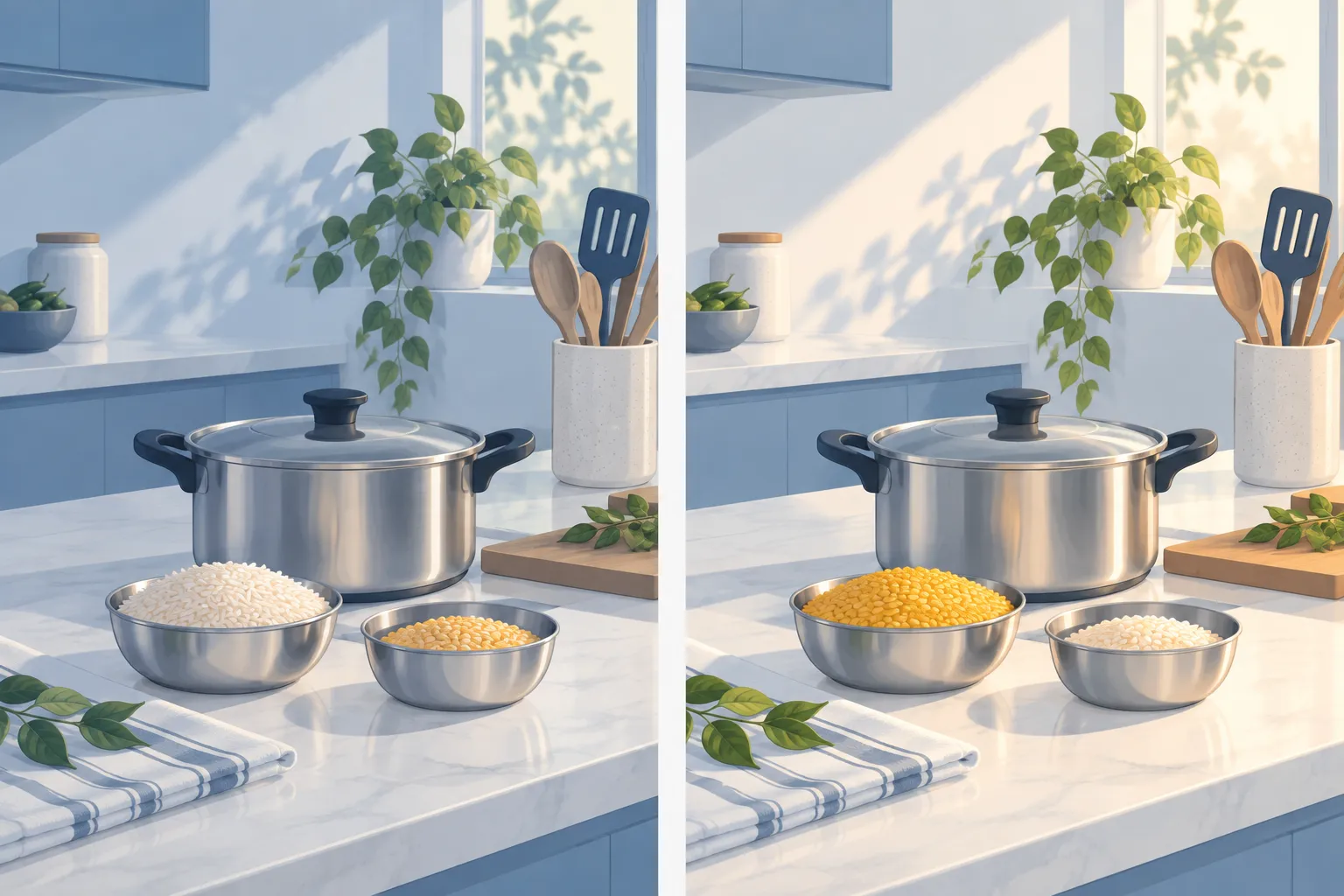
The usual wayMore rice than dal in the khichdi measure
This wayA little more dal, a little less rice
How to do it
- Measure the dal and the rice before they go into the pot.
- Use a little more dal and a little less rice than usual.
- Cook it as always, soft, and pour the kadhi over it.
Filling the plate
Ba's pots feed everyone, including the person managing their weight. NIN's plate is for a whole day, and its proportions carry over to this dinner: roughly half vegetables, cereals and millets as the next largest share, then pulses and dairy.[1]
Give the green sabzi the most room, a bigger helping than usual that fills close to half the plate. Then choose 1 grain to lead: a small mound of khichdi with a rotla, or a rotla and a half with a spoonful of khichdi. Kadhi goes over the khichdi as it always has.
- Half: the green sabzi, a bigger helping than usual
- Most of the rest: 1 grain to lead: a small mound of khichdi with a rotla, or a rotla and a half
- The rest: the dal in the khichdi, the kadhi and the chaas
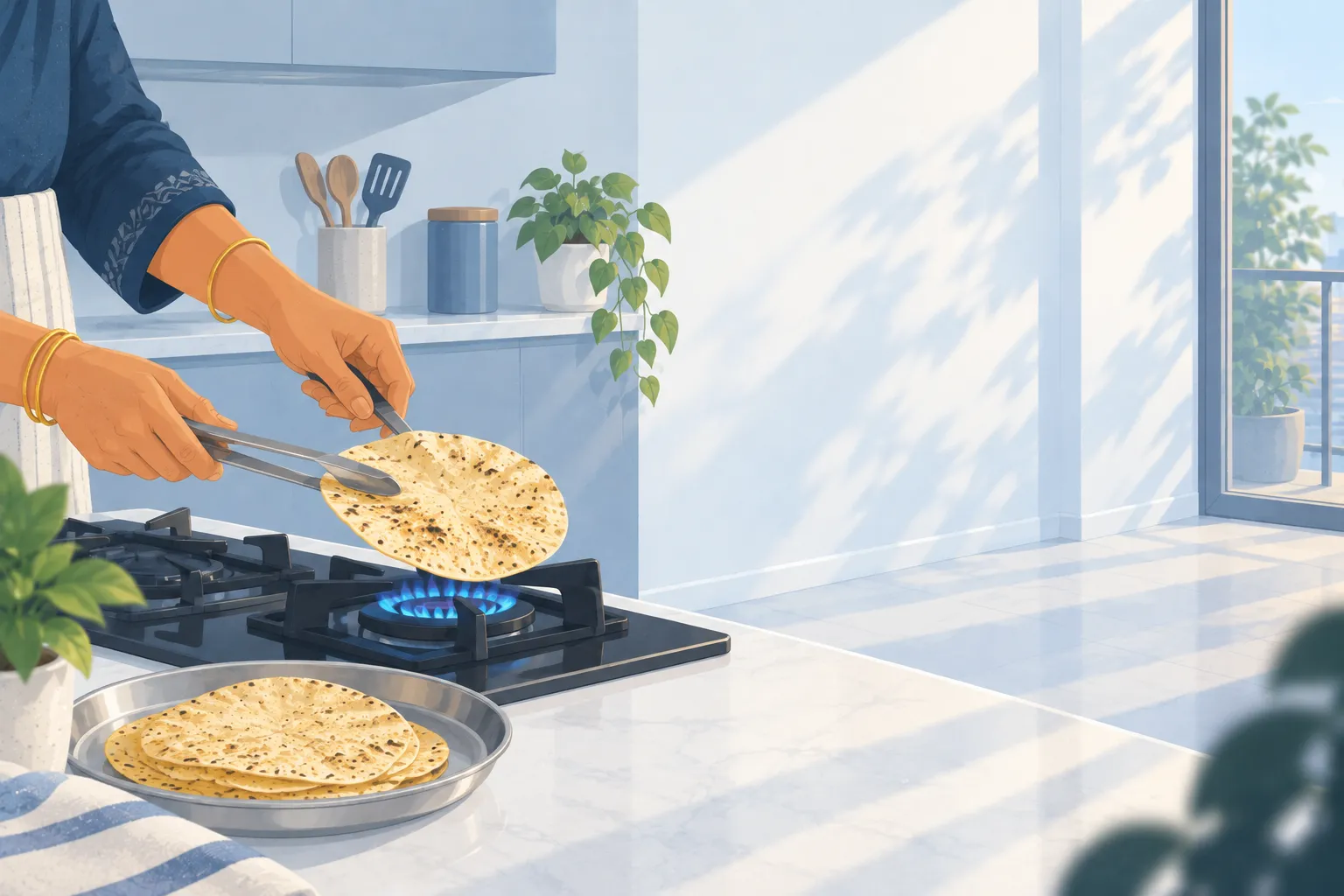
Ghee, if you take it, is a measured teaspoon on the khichdi or the rotla, and the ghee in the kadhi's tadka counts towards NIN's 1 to 2 teaspoons a day as well.[1] The papad is roasted over the flame instead of fried, which leaves out the oil but keeps the salt, so it stays at 1 each.
Ba's kadhi and the grandchildren
The kadhi is Ba's recipe, and changing it goes better as a question than as an instruction. Ask her to make a batch with half the sugar and say whether it still tastes like hers. If it does not, a little less than usual is still a change the whole table eats.
If you are the one managing your weight, these changes start in the kitchen and need no separate meal.
Tonight the papads come off the gas flame, 1 for each plate, and the kadhi goes round in Ba's pan.
If anyone at the table has diabetes, high blood pressure or kidney disease, their own doctor or dietitian may set different targets from the general guidelines here. Anyone who takes medicine for diabetes should check with their doctor before eating less khichdi or rotla at dinner.
To have a doctor look at the whole picture, including what your family cooks, you can book a consultation.
Raw bajra has several times the fibre of raw milled rice. In the ICMR-INDIAB dietary survey, though, swapping grains without eating less of them was not linked to lower odds of abdominal obesity. NIN's guidance is about how much cereal is on the plate.
Yes. Add less sugar or jaggery than usual, taste, and add more only if it needs it. The national dietary guidelines count jaggery as added sugar, the same as white sugar.
No. Roasting leaves out the frying oil, but the salt is in the papad itself, so keeping to a single papad still matters.
Sources
- ICMR-NIN Expert Committee. Dietary Guidelines for Indians - 2024. Hyderabad: ICMR-National Institute of Nutrition; 2024. Available from: nin.res.inCited atp. 58p. 90p. 1p. 94pp. 93-4p. 5pp. 54, 74p. 94p. 94p. 58pp. iv, 6p. 54
- Longvah T, Ananthan R, Bhaskarachary K, Venkaiah K. Indian Food Composition Tables 2017. Hyderabad: National Institute of Nutrition, Indian Council of Medical Research; 2017. Available from: nin.res.inCited atTables 1, 2, 4 and 5Table 1, p. 3
- Anjana RM, Sudha V, Abirami K, Gayathri R, Manasa VS, et al. Dietary profiles and associated metabolic risk factors in India from the ICMR-INDIAB survey-21. Nat Med. 2025;31(11):3813-24. doi:10.1038/s41591-025-03949-4. PMID: 41028544. Available from: nature.comCited atExtended Data Table 3Extended Data Table 3
- National Sample Survey Office. Survey on Household Consumption Expenditure: 2022-23. New Delhi: Ministry of Statistics and Programme Implementation; 2024. NSS Report No. 591. Available from: mospi.gov.inCited atTable 3.8R, p. 34
- National Statistics Office. Nutritional Intake in India (2022-23 & 2023-24). New Delhi: Ministry of Statistics and Programme Implementation; 2025. NSS Report No. 594. Available from: mospi.gov.inCited atTable 3.10, p. 40Table 3.10, p. 40