A Punjabi family dinner: keep the dal, measure the butter
A Punjabi weeknight of dal, aloo-gobhi, raita and rotis, and 3 small swaps for the butter, the pickle and the roti count.
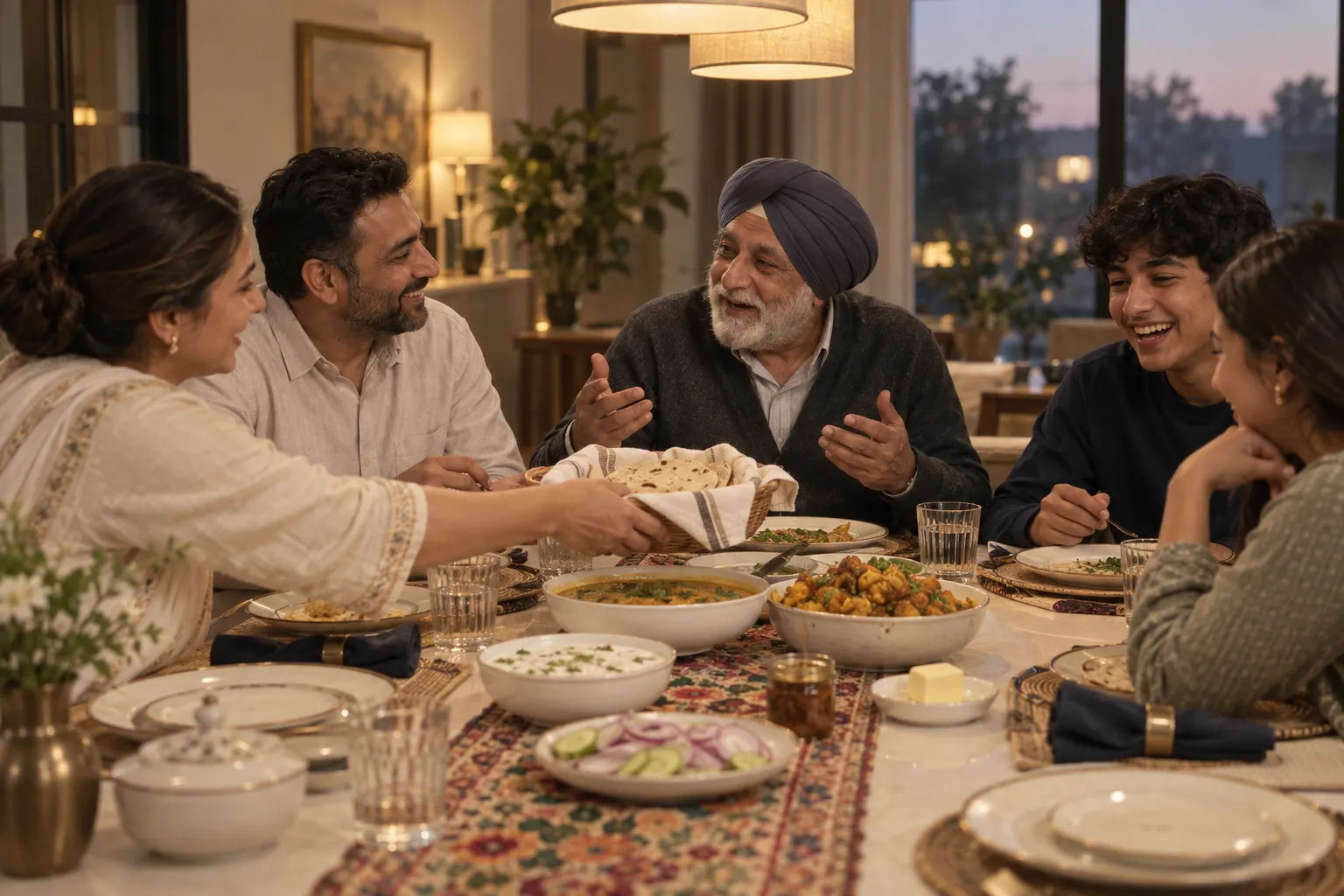
The rotis arrive in a cloth-lined basket and go round the table more than once. Around them sit a pot of dal, a bowl of aloo-gobhi, raita, sliced onion and cucumber, a jar of pickle and a small dish of butter. Grandparents, parents and children eat together, and nobody would call it a special meal.
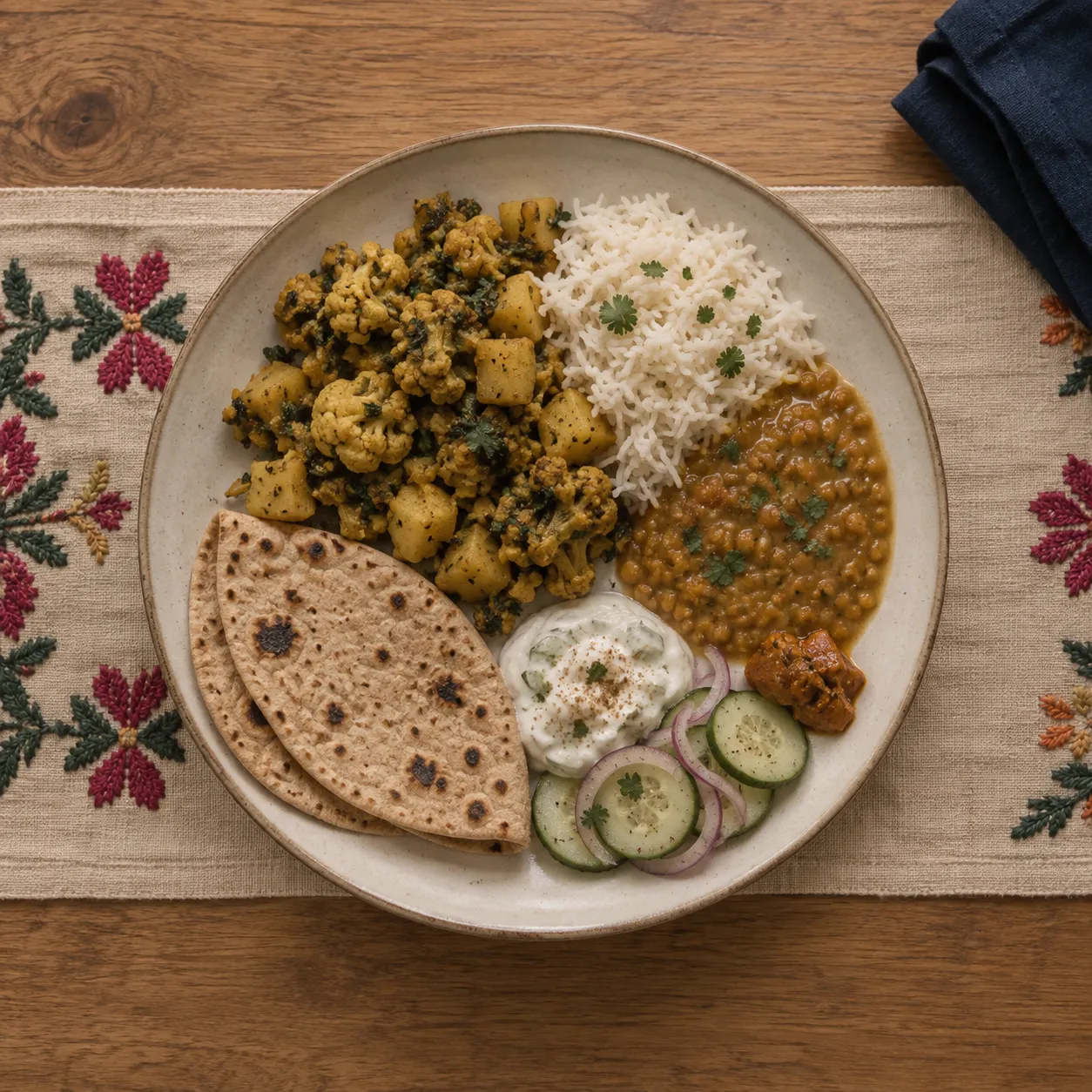
- Aloo-gobhi potato and cauliflower
- Rotis whole wheat, from the basket
- Dal from the pot
- Raita
- Pickle from the jar
- Onion and cucumber sliced
| Per 100 g raw | Energykcal | Proteing | Carbsg | Fatg | Fibreg |
|---|---|---|---|---|---|
| Atta (whole wheat) | 320 | 10.6 | 64.2 | 1.5 | 11.4 |
| Masoor dal | 322 | 24.4 | 52.5 | 0.8 | 10.4 |
| Cauliflower | 23 | 2.2 | 2.0 | 0.4 | 3.7 |
| Potato | 70 | 1.5 | 14.9 | 0.2 | 1.7 |
| Cucumber | 20 | 0.7 | 3.5 | 0.2 | 2.1 |
| Onion | 48 | 1.5 | 9.6 | 0.2 | 2.5 |
| Per 100 g raw | Ironmg | Folateµg | Zincmg | Calciummg | β-caroteneµg |
|---|---|---|---|---|---|
| Atta (whole wheat) | 4.1 | 29 | 2.9 | 31 | 3 |
| Masoor dal | 7.1 | 50 | 3.6 | 44 | 6 |
| Cauliflower | 1.0 | 46 | 0.3 | 25 | 2 |
| Potato | 0.6 | 16 | 0.3 | 10 | none |
| Cucumber | 0.5 | 17 | 0.2 | 16 | 5 |
| Onion | 0.4 | 29 | 0.4 | 21 | 1 |
Per 100 g of each raw ingredient, not a cooked helping. Bold marks the ingredient with the most of each micronutrient per 100 g raw. That is not what a served portion delivers. "none" means none is listed.
Values: Indian Food Composition Tables 2017.[2]
This is often the first dinner a diet takes away. The dal, the raita and the salad can stay as they are. Watch the butter, the pickle, and how many times the basket comes back.
Dal, raita and whole-wheat rotis
Dal and roti put a pulse and a cereal on the same plate. ICMR-NIN's Dietary Guidelines for Indians (2024) say that combination supplies all the amino acids and gives better-quality protein than either alone, at about 3 parts cereal to 1 part pulse by raw weight.[1]
The Indian Food Composition Tables list raw masoor dal at about 24 g of protein per 100 g.[2] Of everything on this table, the dal pot is the pot worth making bigger.
Curd has its place in NIN's picture of a healthy meal, beside generous vegetables, whole grains and pulses, with little oil or salt.[1] The sliced onion and cucumber cover another of its habits: some fresh, non-starchy vegetable at every meal.[1]
And the rotis are whole wheat.
Both figures are for the raw flour or grain.[2]
The rotis that come round again
In Punjab, the grain is wheat.
2022-23 household consumption survey.[4]
Share of the day's energy, adults in Punjab (ICMR-INDIAB, 2012-13).[3] The ceiling covers all cereals and millets together, so the atta alone sits close to it.[1]
Here, the number of rotis that go round matters most.
Butter on the roti, salt in the jar
In many Punjabi homes, butter or ghee goes on the rotis as they come off the tawa, the flat griddle, often on each of them. Fat carries 9 kcal per gram, against 4 kcal for protein or carbohydrate, so a thin layer on every roti adds up over a stack.[2]
If the dal's tadka, the spices tempered in hot fat, is made in vanaspati, a partially hydrogenated vegetable fat, NIN advises against it because it may contain trans fats.[1]
Then the pickle. NIN names home-made pickles and papads among foods high in salt, and salted butter among the foods that add to it. It sets the limit at 5 g of salt a day, about 1 teaspoon.[1]
1 teaspoon is a level teaspoon, not heaped: about 5 g of oil, ghee or salt.
NIN's figures for sedentary adults, for the whole day. It counts 20 to 50 g of cooking fat as 4 to 10 teaspoons, and 5 g of salt as 1 teaspoon.[1]
Butter dish, roti basket, pickle jar
- A teaspoon in the butter dish. Put a teaspoon in the dish instead of a knife. The person managing their weight takes a level teaspoon at dinner and picks the roti it goes on, and NIN's limit of 1 to 2 teaspoons of ghee or butter a day, or none where possible, becomes an amount you can see.[1]
- When the basket comes round again, pass it on. The second or third roti becomes a second katori, a small bowl, of dal, and the basket carries on round the table. Dal is the pulse already here, and the one worth a bigger share of the plate.
- Pickle at the edge, salad in the middle. A small spoon of pickle sits on the side of the plate, where it seasons a bite at a time, and the onion-cucumber bowl moves to the centre of the table and gets refilled. The sourness and heat stay; the pickle, which NIN lists among high-salt foods, shrinks to a garnish.[1]
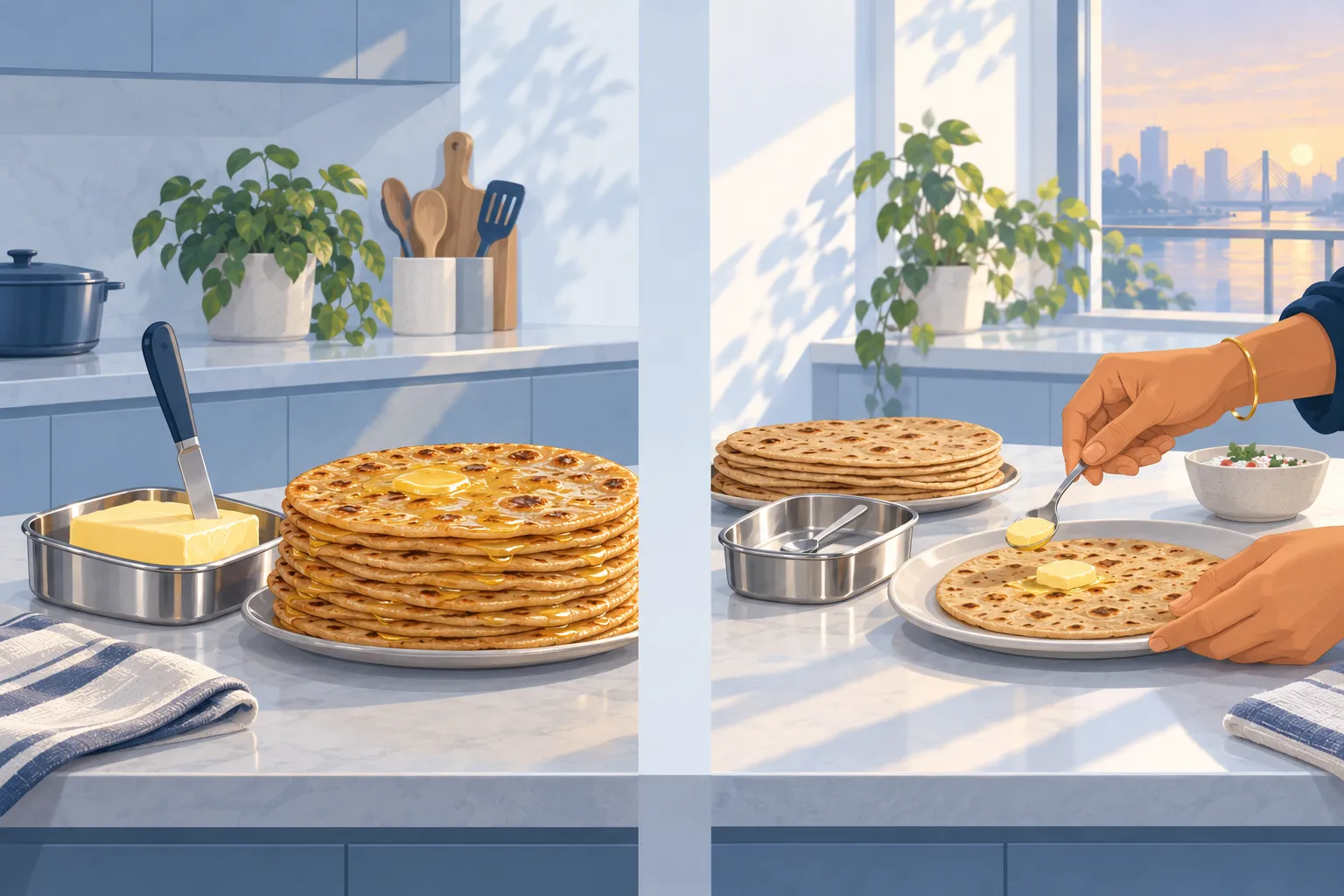
The usual wayButter spread on every roti with a knife
This wayOne level teaspoon, on the roti you choose
How to do it
- Put a teaspoon in the butter dish instead of a knife.
- Take one level teaspoon at dinner, and choose the roti it goes on.
- When the basket comes round again, take a second katori of dal instead.
Fat carries 9 kcal a gram, against 4 for protein or carbohydrate.[2]
How the plate fills up
The person managing their weight eats what everyone else eats. Applied to this dinner, NIN's whole-day plate gives about half to vegetables, greens, fruit and roots, then cereals and millets as the next largest share, followed by pulses, nuts, and milk or curd.[1]
That half includes the aloo. It stays, and the gobhi and salad fill most of the half.
- Half: aloo-gobhi, heavier on the gobhi, and a full helping of onion and cucumber
- Most of the rest: rotis, fewer than usual, with a level teaspoon of butter
- The rest: a full katori of dal and a bowl of raita
The pickle is a small spoon at the edge.
Who holds the butter dish
The cook decides how much butter goes into the tadka, and the cook is often not the person trying to change. A spoon in the butter dish and a bigger pot of dal are easier on the cook than a second dinner every night.
If you are the person managing your weight, the teaspoon and the second katori are changes you can make tonight.
After dinner, the teaspoon is still in the butter dish, where the knife used to be.
If anyone at the table has diabetes, high blood pressure or kidney disease, their own doctor or dietitian may set different targets from the general guidelines here. Anyone who takes medicine for diabetes should check with their doctor before eating less roti at dinner.
To have a doctor look at the whole picture, including what your family eats, you can book a consultation.
Not on its own. Whole wheat and millet flour still count as cereal, and in the ICMR-INDIAB dietary survey a like-for-like flour swap was not linked to lower odds of abdominal obesity. How many rotis you eat, and the dal and vegetables beside them, is where the change is.
No. The ICMR-NIN dietary guidelines limit ghee or butter to a small daily amount, counted in teaspoons. Putting a spoon in the butter dish keeps it on the table and makes the amount easy to see.
If anyone at the table has diabetes, high blood pressure or kidney disease, their own doctor or dietitian may set different targets from the general guidelines here. Anyone who takes medicine for diabetes should check with their doctor before eating less roti at dinner.
Sources
- ICMR-NIN Expert Committee. Dietary Guidelines for Indians - 2024. Hyderabad: ICMR-National Institute of Nutrition; 2024. Available from: nin.res.inCited atp. 58p. 1p. 1p. 5p. 56p. 74pp. 54, 74p. 54p. 94pp. iv, 6
- Longvah T, Ananthan R, Bhaskarachary K, Venkaiah K. Indian Food Composition Tables 2017. Hyderabad: National Institute of Nutrition, Indian Council of Medical Research; 2017. Available from: nin.res.inCited atTables 1, 2, 4 and 5Table 1, p. 4Table 1, pp. 3-4Table 4, p. xxiTable 4, p. xxi
- Anjana RM, Sudha V, Abirami K, Gayathri R, Manasa VS, et al. Dietary profiles and associated metabolic risk factors in India from the ICMR-INDIAB survey-21. Nat Med. 2025;31(11):3813-24. doi:10.1038/s41591-025-03949-4. PMID: 41028544. Available from: nature.comCited atExtended Data Table 3
- National Sample Survey Office. Survey on Household Consumption Expenditure: 2022-23. New Delhi: Ministry of Statistics and Programme Implementation; 2024. NSS Report No. 591. Available from: mospi.gov.inCited atTable 3.8R, p. 34