Rice once, sambar twice at a Tamil family table
A Tamil Nadu rice meal of sambar, rasam, kootu, poriyal and curd, and how to serve less rice without changing the courses.
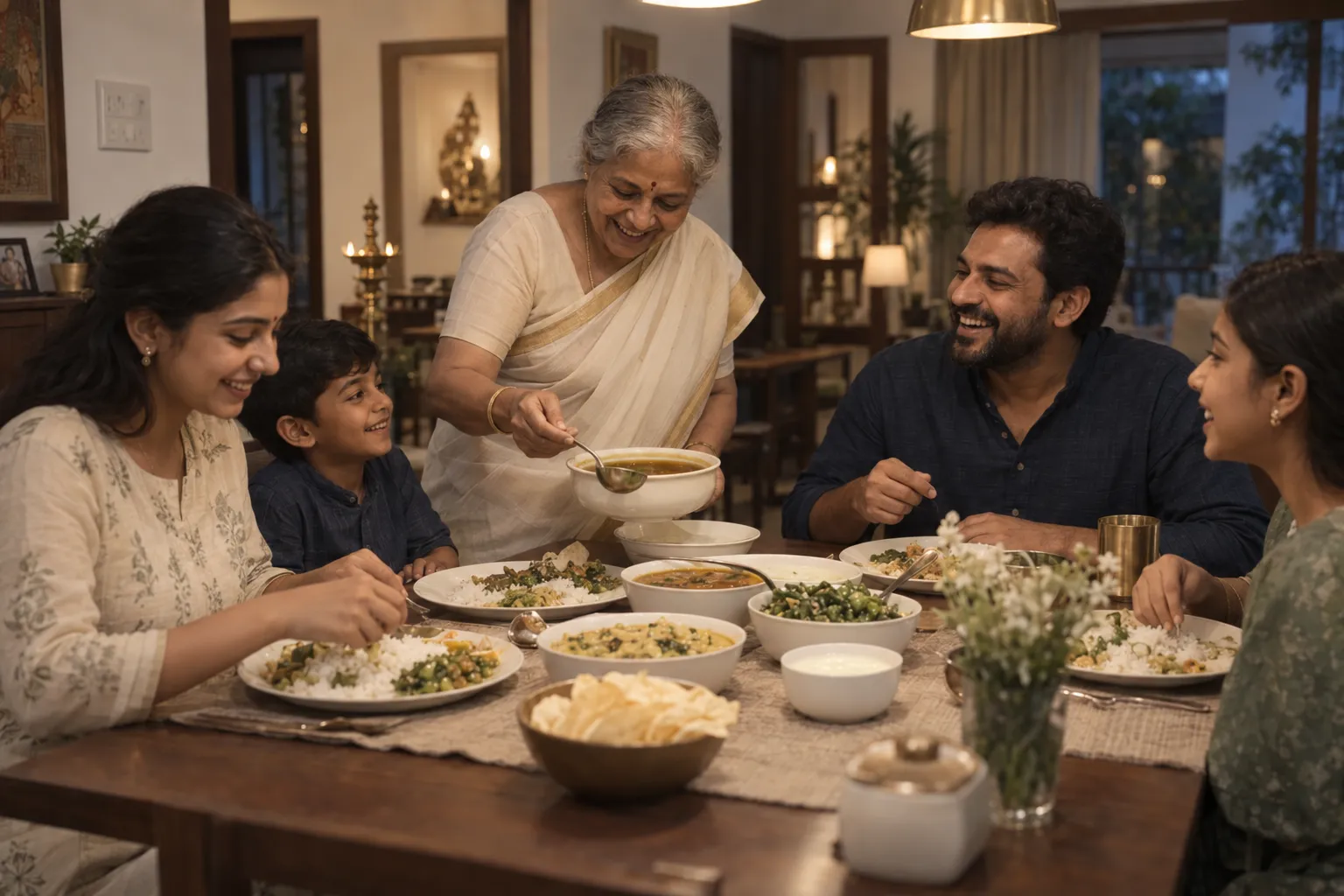
The son-in-law holds his plate out for rasam, a thin, sour broth, before the sambar round is quite finished, and the grandmother is already tipping the ladle. Around the steel rice vessel sit the sambar, beans poriyal (a dry stir-fry), a vegetable kootu (vegetables simmered with dal), a bowl of curd and a small stack of appalam, the Tamil papad. In many homes this is the midday meal, and it turns up at dinner too.
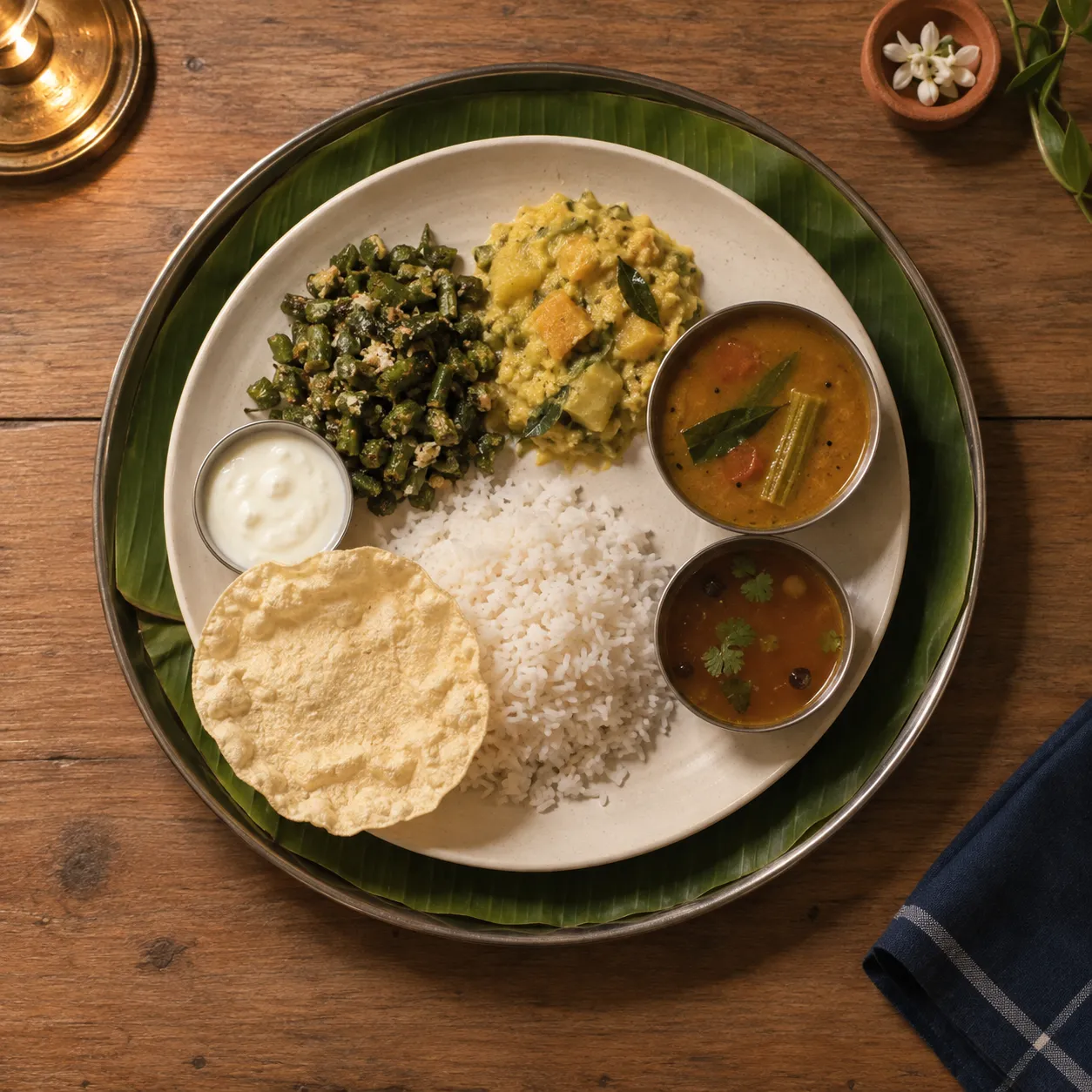
- Beans poriyal a dry stir-fry
- Curd to finish
- Appalam the Tamil papad
- Kootu vegetables simmered with dal
- Sambar the first round
- Rasam a thin, sour broth
- Rice from the steel vessel
| Per 100 g raw | Energykcal | Proteing | Carbsg | Fatg | Fibreg |
|---|---|---|---|---|---|
| Rice, milled | 356 | 7.9 | 78.2 | 0.5 | 2.8 |
| Tur dal | 331 | 21.7 | 55.2 | 1.6 | 9.1 |
| French beans | 24 | 2.5 | 2.7 | 0.3 | 4.4 |
| Per 100 g raw | Ironmg | Folateµg | Zincmg | Calciummg | β-caroteneµg |
|---|---|---|---|---|---|
| Rice, milled | 0.7 | 9 | 1.2 | 7 | none |
| Tur dal | 3.9 | 108 | 2.6 | 72 | 127 |
| French beans | 1.3 | 47 | 0.5 | 56 | 413 |
Per 100 g of each raw ingredient, not a cooked helping. Bold marks the ingredient with the most of each micronutrient per 100 g raw. That is not what a served portion delivers. "none" means none is listed.
Values: Indian Food Composition Tables 2017.[3]
The rice goes round 3 times: first with sambar, then with rasam, then with curd to finish. For anyone here managing their weight, that order is worth keeping, and every change below keeps it.
The pulse in the sambar
The sambar is often built on tur dal, which has nearly 3 times the protein of milled rice, per 100 g raw. A ladle of sambar is mostly water and vegetables, though.[3]
ICMR-NIN's 2024 guidelines add that cereal and pulse eaten together give better-quality protein than either alone, at roughly 3 parts cereal to 1 part pulse by raw weight.[1] Rice with sambar, and rice with kootu, is that pairing.
Poriyal and kootu give vegetables 2 dishes of their own. NIN's "My Plate for the Day" gives vegetables, greens, roots and fruit about half the plate.[1]
Curd closes the meal. NIN describes a healthy meal as including plain curd.[1]
of women aged 15 to 49 in Tamil Nadu had milk or curd at least once a week (NFHS-5).[4]
of men aged 15 to 49 in Tamil Nadu did the same.[4]
Sugar is modest in this diet. Across the whole day, added sugar supplied a median of 4.8% of energy for adults in Tamil Nadu in the ICMR-INDIAB survey, surveyed in 2008 to 2010.[2]
Rice and the day's energy
Rice carries most of this meal.
Share of the day's energy, adults in Tamil Nadu (ICMR-INDIAB, 2008 to 2010).[2] The ceiling is NIN's, for all cereals and millets.[1]
Salt and oil in every pot
Salt goes separately into the sambar, the rasam, the poriyal and the kootu, and the appalam brings its own. NIN names papads and pickles among the home-prepared foods high in salt, and sets an adult limit of 5 g of salt a day, about 1 teaspoon.[1]
The tempering repeats too. Mustard seeds and curry leaves often go into hot oil for each dish, and a deep-fried appalam adds more. NIN counts deep-fried foods as high-fat foods.[1]
1 teaspoon is a level teaspoon, not heaped: about 5 g of oil, ghee or salt.
NIN's figures for sedentary adults, for the whole day. It counts 20 to 50 g of cooking fat as 4 to 10 teaspoons, and 5 g of salt as 1 teaspoon.[1]
Rice, kootu and one appalam
- Rice once, sambar twice. Serve the rice at the start and let that single serving last all 3 courses. When the sambar comes round again, take the sambar. Rasam carries its own salt, so it goes into a small tumbler to sip instead of over fresh rice. The courses keep their order, and there is more dal for the rice, closer to NIN's 3 to 1 cereal-to-pulse ratio.[1]
- A thicker kootu. Add an extra handful of dal to the kootu, or a second vegetable to the sambar, so the dishes around the rice carry more of the plate. The dishes stay the same, with more dal and vegetables beside the rice, the cereal and pulse pairing NIN describes.[1]
- 1 appalam, roasted. Roast it over the gas flame or in an air fryer, and in many homes it still ends up crushed over the last of the curd rice. NIN prefers grilling, steaming and baking to frying, and notes that food absorbs significantly less oil in an air fryer than in deep frying.[1] The crunch stays. The salt is the same roasted or fried, and 1 appalam carries less of it than a stack.
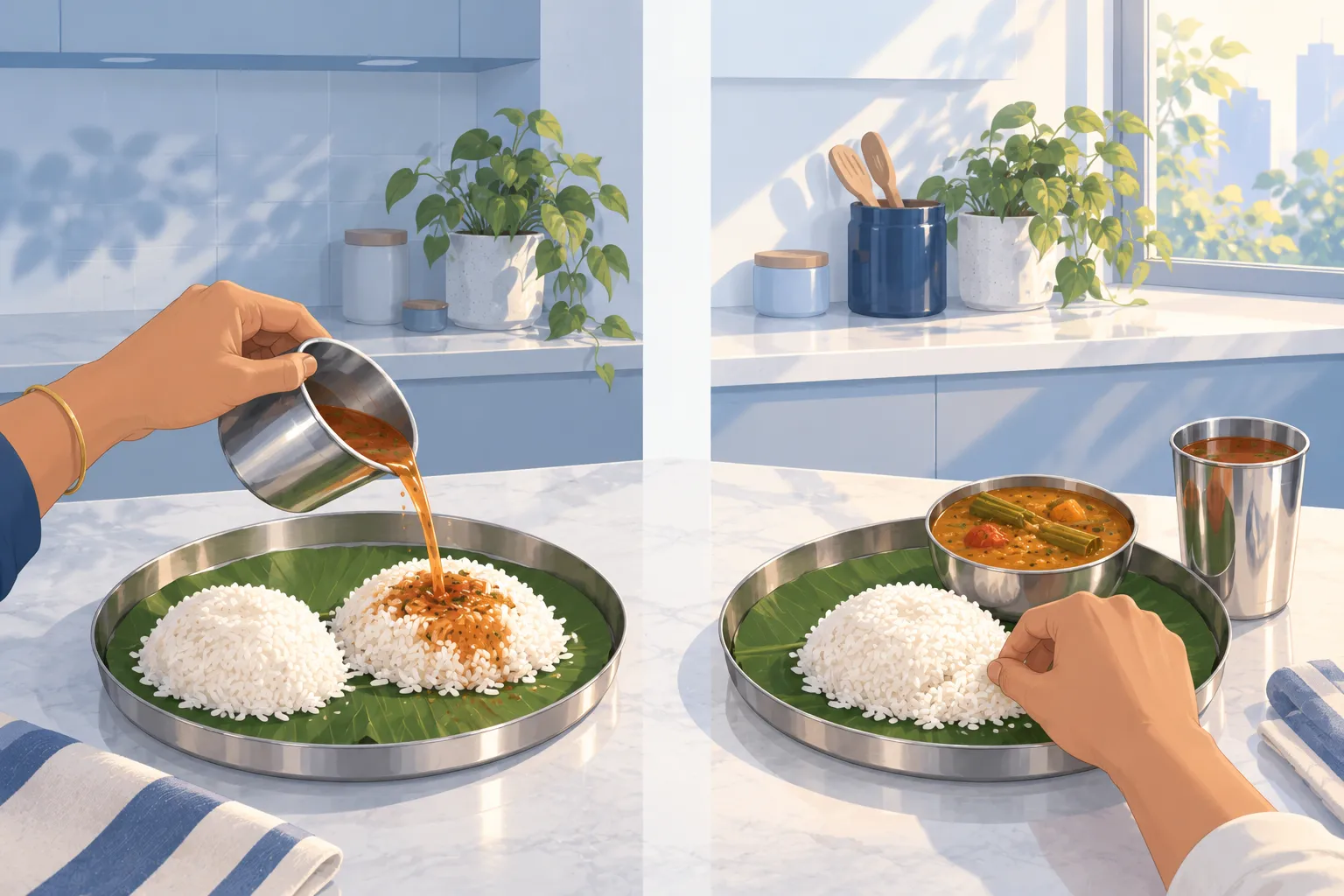
The usual wayRasam poured over a fresh helping of rice
This wayRasam in a small tumbler, beside the rice
How to do it
- Set small steel tumblers beside the rasam pot.
- When the rasam comes round, pour it into a tumbler instead of over fresh rice.
- Sip it with the rice already on the plate.
Poriyal and kootu on one plate
NIN's plate is drawn for a whole day, and this meal borrows its proportions: poriyal and kootu take about half the plate.[1] The rice goes into the space left, with sambar poured over it generously. Rasam comes in the small tumbler, curd finishes the meal as it always has, and the roasted appalam sits at the edge.
- Half: poriyal and kootu
- Most of the rest: rice, one modest mound
- The rest: sambar poured over generously, rasam in a small tumbler, and curd to finish
The son-in-law and the grandmother
The person managing their weight may be the son-in-law or his wife, in their 50s. Nobody cooks a second dinner for them here. Their smaller first serving of rice and heavier ladle of kootu come out of the same vessels as everyone else's.
When the rasam round comes, the grandmother pours theirs into the small tumbler, and the meal carries on in its usual order.
If anyone at the table has diabetes, high blood pressure or kidney disease, their own doctor or dietitian may set different targets from the general guidelines here. Anyone who takes medicine for diabetes should check with their doctor before eating less rice at dinner.
To have a doctor look at the whole picture, sambar and rice included, you can book a consultation.
Yes. Keep the courses in the same order, start with less rice on the plate, and take more sambar, kootu and poriyal around it.
Roasting over a flame or in an air fryer uses little or no oil. The salt in the appalam is the same either way, so a single appalam per plate is a sensible habit.
If anyone at the table has diabetes, high blood pressure or kidney disease, their own doctor or dietitian may set different targets from the general guidelines here. Anyone who takes medicine for diabetes should check with their doctor before eating less rice at dinner.
Sources
- ICMR-NIN Expert Committee. Dietary Guidelines for Indians - 2024. Hyderabad: ICMR-National Institute of Nutrition; 2024. Available from: nin.res.inCited atp. 58p. 6p. 1p. 5pp. 74, 94p. 93pp. 54, 74p. 58p. 58pp. 51, 86p. 5p. 6
- Anjana RM, Sudha V, Abirami K, Gayathri R, Manasa VS, et al. Dietary profiles and associated metabolic risk factors in India from the ICMR-INDIAB survey-21. Nat Med. 2025;31(11):3813-24. doi:10.1038/s41591-025-03949-4. PMID: 41028544. Available from: nature.comCited atExtended Data Table 3Extended Data Table 3Extended Data Table 3
- Longvah T, Ananthan R, Bhaskarachary K, Venkaiah K. Indian Food Composition Tables 2017. Hyderabad: National Institute of Nutrition, Indian Council of Medical Research; 2017. Available from: nin.res.inCited atTables 1, 2, 4 and 5Table 1, pp. 3, 5
- International Institute for Population Sciences (IIPS), ICF. National Family Health Survey (NFHS-5), 2019-21: India: Volume I. Mumbai: IIPS; 2021. Available from: dhsprogram.comCited atTable 10.27.1, p. 440Table 10.27.2, p. 441