Keeping the pappu at a Telangana family dinner
A Hyderabad weeknight of rice, tomato pappu, chicken curry, gongura pachadi and curd, and 3 changes to how much of each goes on the plate.
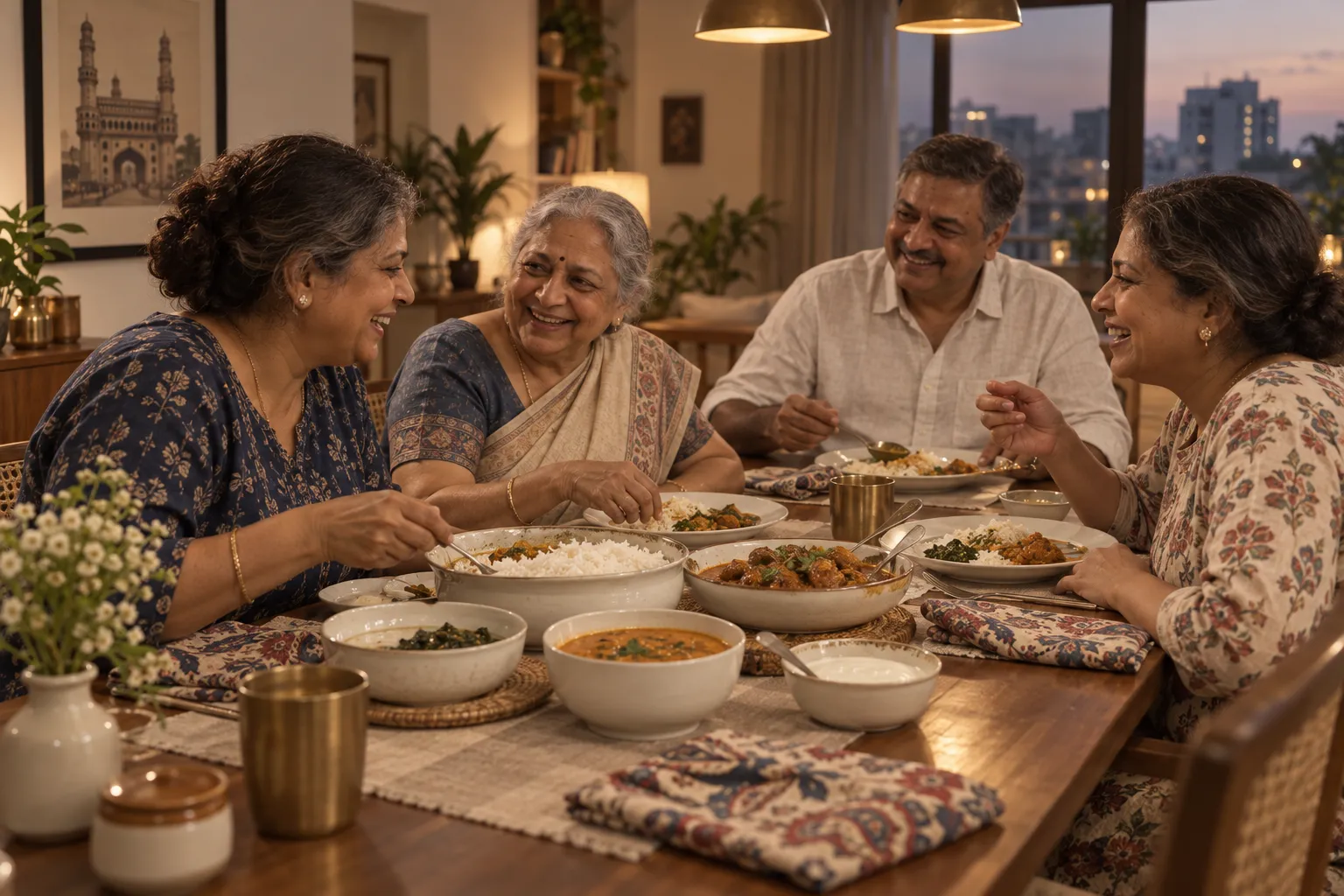
The gongura pachadi jar is open before anyone has sat down. Around it on a Hyderabad dinner table: rice in a steel vessel, a pot of tomato pappu (dal) cooked soft and a little sour, a home-style chicken curry and a bowl of curd for the end of the meal. The 2 sisters, both in their 50s, have come over, their mother sits between them, laughing, and a husband has the far end of the table.
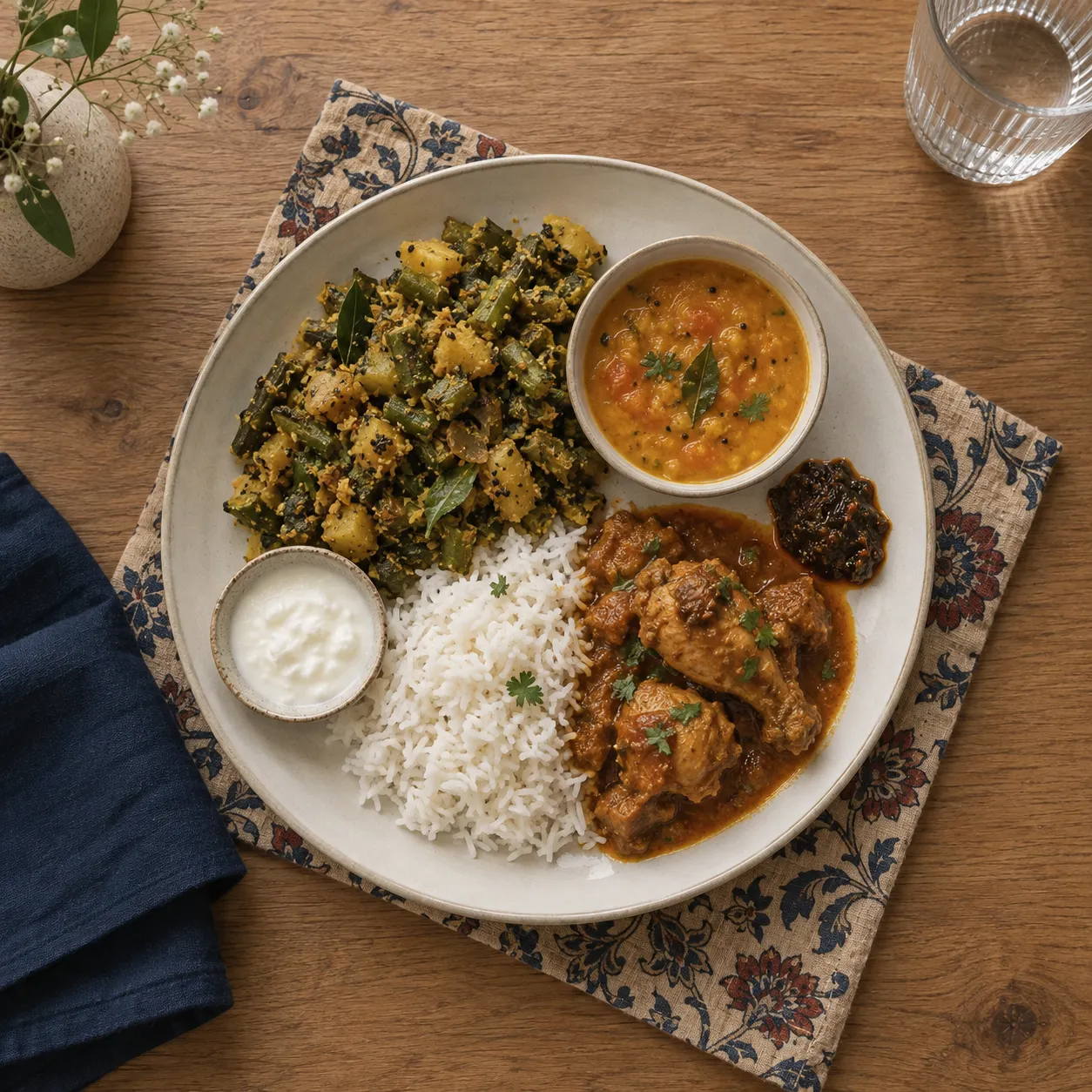
- Koora a vegetable curry
- Curd for the end of the meal
- Rice from the steel vessel
- Pappu tomato dal, soft and a little sour
- Gongura pachadi from the jar
- Chicken curry home-style
| Per 100 g raw | Energykcal | Proteing | Carbsg | Fatg | Fibreg |
|---|---|---|---|---|---|
| Rice, milled | 356 | 7.9 | 78.2 | 0.5 | 2.8 |
| Tur dal | 331 | 21.7 | 55.2 | 1.6 | 9.1 |
| Tomato, ripe | 20 | 0.9 | 2.7 | 0.5 | 1.8 |
| Chicken thigh, skinless | 200 | 18.2 | none | 14.2 | none |
| Gogu leaves | 36 | 1.9 | 4.1 | 1.1 | 4.6 |
| Per 100 g raw | Ironmg | Folateµg | Zincmg | Calciummg | β-caroteneµg |
|---|---|---|---|---|---|
| Rice, milled | 0.7 | 9 | 1.2 | 7 | none |
| Tur dal | 3.9 | 108 | 2.6 | 72 | 127 |
| Tomato, ripe | 0.3 | 19 | 0.1 | 10 | 905 |
| Chicken thigh, skinless | 1.1 | 9 | 1.4 | 18 | none |
| Gogu leaves | 7.7 | 75 | 0.7 | 145 | 5,285 |
Per 100 g of each raw ingredient, not a cooked helping. Bold marks the ingredient with the most of each micronutrient per 100 g raw. That is not what a served portion delivers. "none" means none is listed.
Values: Indian Food Composition Tables 2017.[2] IFCT has no gongura row; this is its gogu leaf (Hibiscus cannabinus), which we take as the nearest match.
The sister who is managing her weight can eat what everyone else eats, with less rice under the pappu, less of the oil that rises on the curry, and fewer spoons from the pachadi jar.
Pappu and chicken on 1 table
Pappu over rice is a cereal-and-pulse pairing. ICMR-NIN's 2024 dietary guidelines say that combining cereals with pulses at about 3:1 by raw weight improves the quality of protein in a meal, and that quality also rises when cereals are eaten with flesh foods, eggs or milk.[1] This table has all 3: dal, chicken and curd.
In many homes the pappu starts with kandi pappu, or tur dal. The Indian Food Composition Tables list 21.7 g of protein per 100 g of the dry, raw dal, before any cooking.[2] That is why the pappu is worth a full katori (small bowl).
Chicken or meat is ordinary food here.
of women aged 15 to 49 in Telangana ate chicken or meat at least once a week (NFHS-5, 2019-20).[3]
of men aged 15 to 49 in Telangana did the same.[3]
The curry is part of the week, and the plate below keeps it.
The curd at the end belongs too. ICMR-NIN describes a healthy meal as generous vegetables, whole grains and pulses, with plain curd alongside.[1]
Rice, curry oil and the jar
Rice is the grain of this kitchen.
About 92% in rural homes and 89% in urban ones, 2022-23 household consumption survey.[4]
Share of the whole day's calories from cereals, estimated from 2022-23 household purchases.[5]
ICMR-NIN's guideline is that cereals and millets supply no more than 45% of daily energy.[1] The rice mound at dinner is the easiest part of that share to see.
The curry is next. The oil that pools on top of a settled curry is part of the day's visible fat, the oil and ghee added in cooking.
Then the pachadi. Gongura, a sour leaf, is ground into pachadi (a relish) that is salted and kept in oil, much like a pickle, and ICMR-NIN lists home-made pickles among high-salt foods. NIN sets the limit for added salt at 5 g a day, about 1 teaspoon.[1] Salt from the pachadi, the pappu and the curry all counts towards the same day.
1 teaspoon is a level teaspoon, not heaped: about 5 g of oil, ghee or salt.
NIN's figures for sedentary adults, for the whole day. It counts 20 to 50 g of cooking fat as 4 to 10 teaspoons, and 5 g of salt as 1 teaspoon.[1]
Pappu, curry oil and pachadi
- The pappu in its own katori. When pappu is poured over a heap of rice, the rice sets the size of the meal. Served in a katori beside the rice, the dal gets a full bowl and the rice can shrink to make room. The cereal ceiling above, and NIN's 3:1 cereal-to-pulse ratio by raw weight, both leave room for more dal beside less rice.[1]
- The oil that rises, spooned off. The masala, the whole spices and the slow cooking stay as they are. Once the curry settles, spoon off the layer of oil on top before it goes to the table, and measure the oil with a spoon the next time it goes into the pot.
- The pachadi jar stays in the kitchen. The gongura stays, sour and sharp, as a spoonful on each plate. A second helping means a trip to the kitchen. NIN names pickles as a high-salt food.[1]
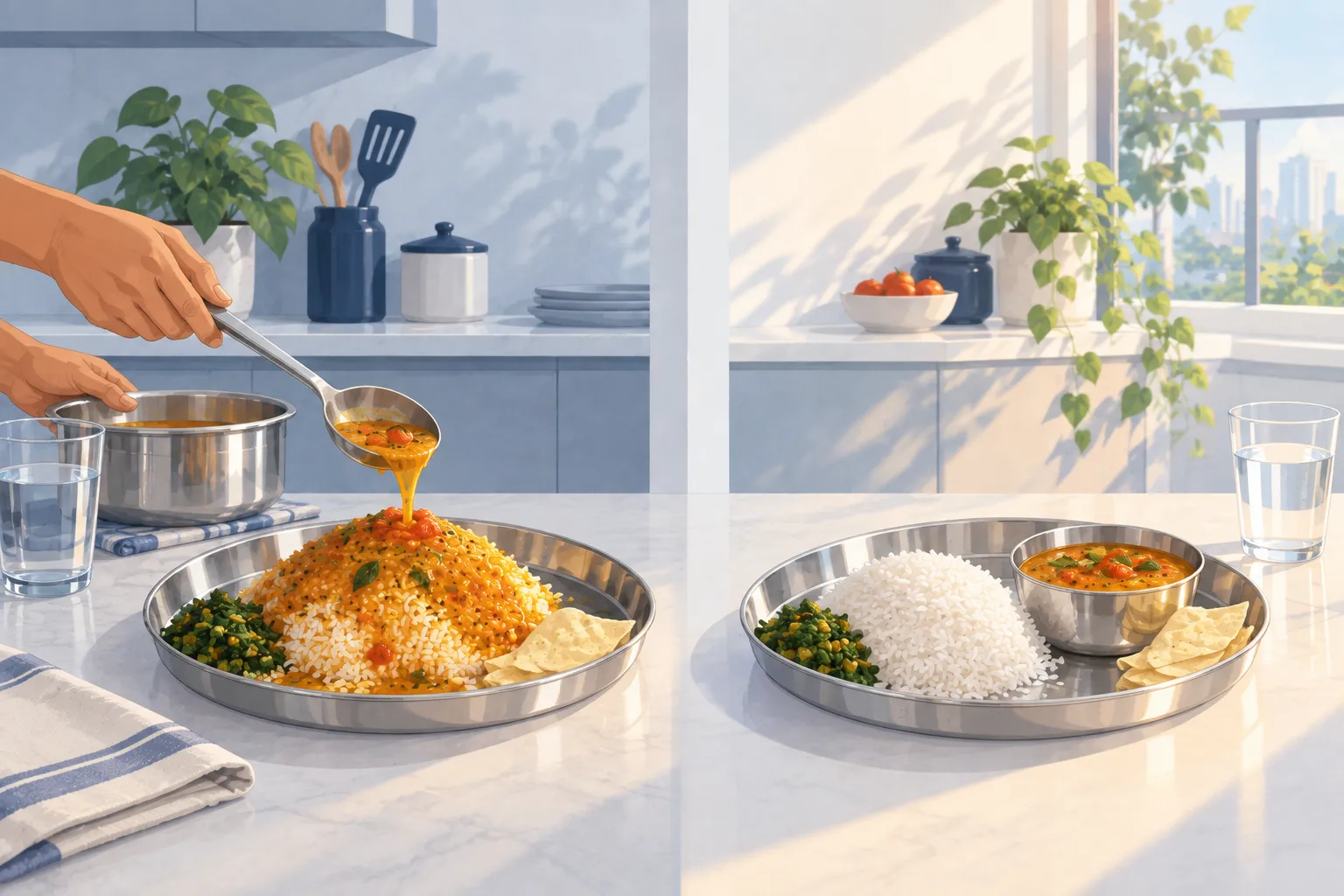
The usual wayPappu poured over a heap of rice
This wayPappu in its own katori, the rice smaller
Making room for a koora
The person managing their weight eats from the same pots as everyone else. ICMR-NIN's plate gives about half its space to vegetables, greens, fruit, roots and tubers, with cereals as the next largest share, followed by pulses, flesh foods, eggs, nuts and milk or curd.[1] NIN draws that plate for a whole day's eating, and here its proportions are borrowed for 1 dinner.
This table is short on vegetables, so add another dish for that half: a koora (a vegetable curry) cooked alongside the chicken if there is one, or sliced cucumber and onion if there is not. Rice comes next, with room left around it. A full katori of pappu and 1 or 2 pieces of chicken sit beside it, then the curd, and a spoonful of pachadi.
- Half: a koora, or sliced cucumber and onion
- Most of the rest: rice, with room left around it
- The rest: a full katori of pappu, 1 or 2 pieces of chicken, and the curd
A spoonful of pachadi sits at the edge.
The sisters and their mother
The recipes here may well be the mother's. Keep them as they are and change the serving.
The pappu goes out in katoris, the curry is skimmed, and the pachadi jar is back on the kitchen shelf.
If anyone at the table has diabetes, high blood pressure or kidney disease, their own doctor or dietitian may set different targets from the general guidelines here. Anyone who takes medicine for diabetes should check with their doctor before eating less rice at dinner.
To have a doctor look at the whole picture, pappu and rice included, you can book a consultation.
Changing the grain on its own may not change much, because rice, chapati and millets all count towards the same cereal share. The size of the rice portion, and what fills the rest of the plate, is the more useful place to start.
No. It is salted and kept in oil, much like a pickle, so a measured spoonful served onto the plate keeps the flavour and leaves the jar in the kitchen.
Yes. Every dish stays, and the changes are to amounts. If anyone at the table has diabetes, high blood pressure or kidney disease, their own doctor or dietitian may set different targets from the general guidelines here. Anyone who takes medicine for diabetes should check with their doctor before eating less rice at dinner.
Sources
- ICMR-NIN Expert Committee. Dietary Guidelines for Indians - 2024. Hyderabad: ICMR-National Institute of Nutrition; 2024. Available from: nin.res.inCited atpp. 58-9p. 1p. 5pp. 74, 76pp. 54, 74p. 58p. 94p. 58p. 5pp. iv, 6
- Longvah T, Ananthan R, Bhaskarachary K, Venkaiah K. Indian Food Composition Tables 2017. Hyderabad: National Institute of Nutrition, Indian Council of Medical Research; 2017. Available from: nin.res.inCited atTables 1, 2, 4 and 5Table 1, p. 5
- International Institute for Population Sciences (IIPS), ICF. National Family Health Survey (NFHS-5), 2019-21: India: Volume I. Mumbai: IIPS; 2021. Available from: dhsprogram.comCited atTable 10.27.1, p. 440Table 10.27.2, p. 441
- National Sample Survey Office. Survey on Household Consumption Expenditure: 2022-23. New Delhi: Ministry of Statistics and Programme Implementation; 2024. NSS Report No. 591. Available from: mospi.gov.inCited atTables 3.8R and 3.8U, pp. 34-5
- National Statistics Office. Nutritional Intake in India (2022-23 & 2023-24). New Delhi: Ministry of Statistics and Programme Implementation; 2025. NSS Report No. 594. Available from: mospi.gov.inCited atTable 3.6, p. 35