A Bengali dinner of rice, dal and fish jhol
A Bengali dinner of rice, masoor dal, fish jhol, shukto and begun bhaja, with the bhaja moved from the frying pan to the tawa.
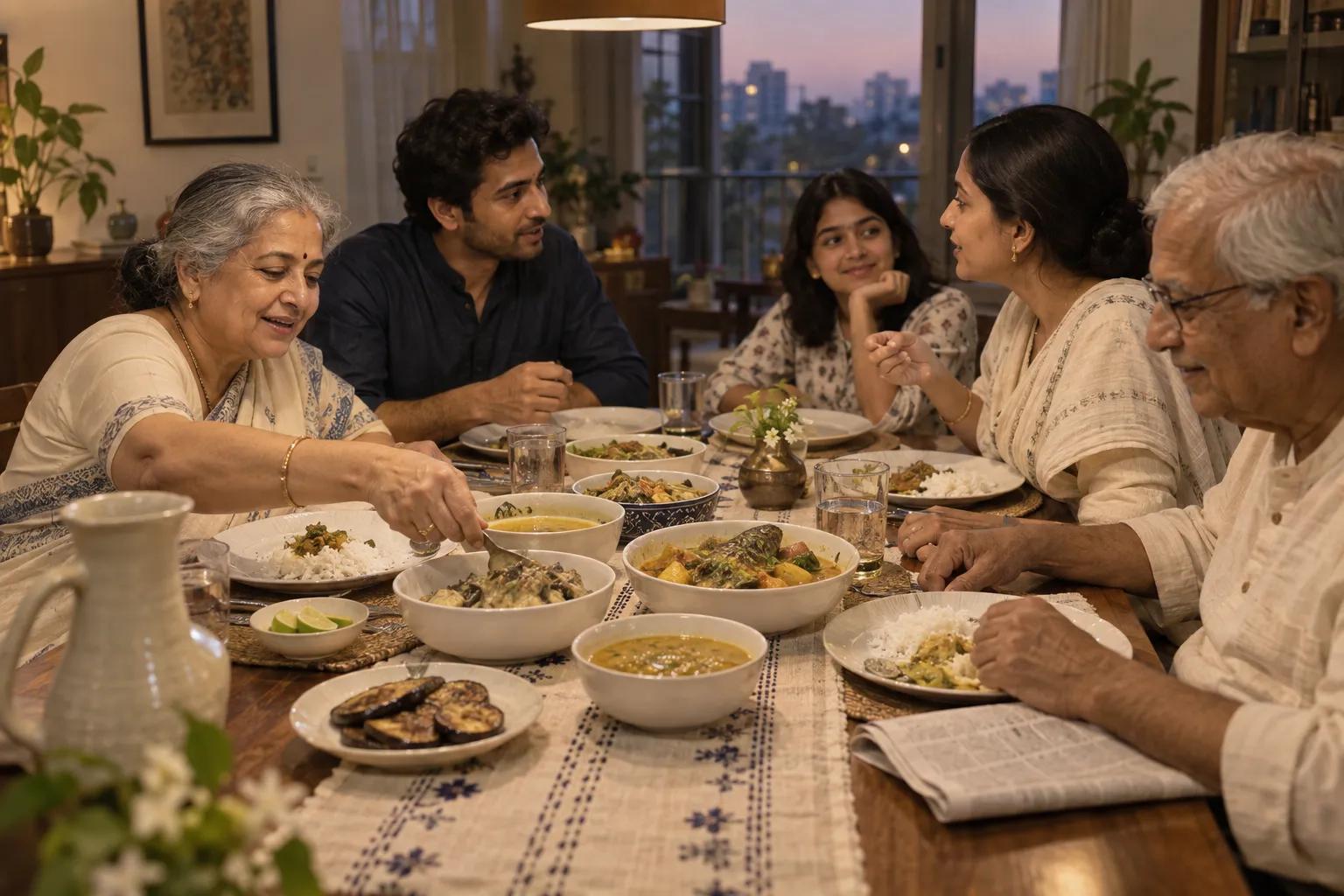
Dadu, the grandfather, has the newspaper folded to the page he wants and has not looked up since the rice arrived. Around him the table is set for an ordinary weeknight: a mound of rice on each plate, masoor dal in a steel bowl, a fish jhol, a thin curry, with pieces of potato in it, shukto, begun bhaja (fried brinjal) straight from the pan, and a lime cut in quarters for the dal. His son and grandchildren are already eating.
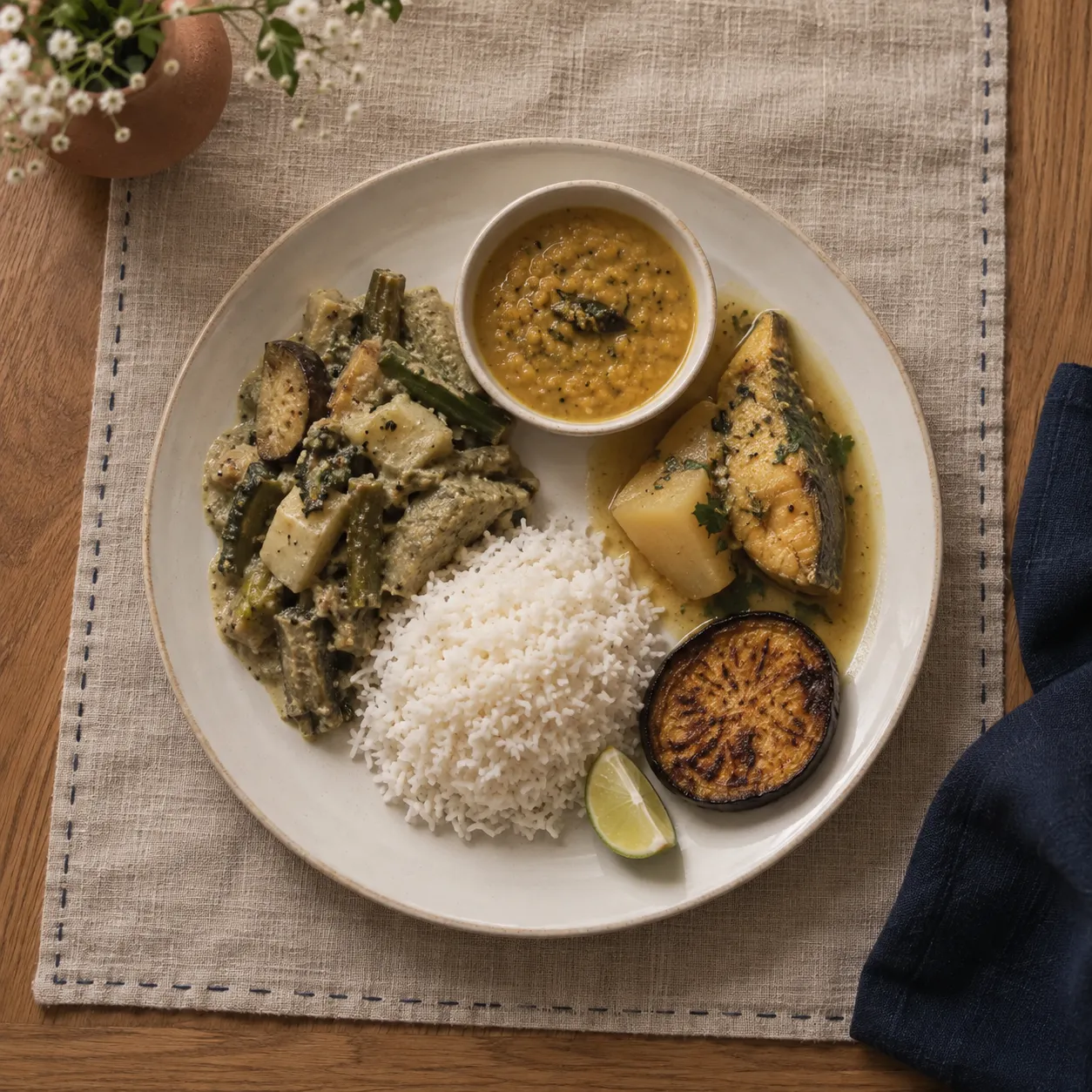
- Shukto mixed vegetables, often starting bitter
- Rice a mound on each plate
- Masoor dal in a steel bowl
- Fish jhol a thin curry, with potato
- Begun bhaja fried brinjal
- Lime for the dal
| Per 100 g raw | Energykcal | Proteing | Carbsg | Fatg | Fibreg |
|---|---|---|---|---|---|
| Rice, milled | 356 | 7.9 | 78.2 | 0.5 | 2.8 |
| Masoor dal | 322 | 24.4 | 52.5 | 0.8 | 10.4 |
| Rohu | 102 | 19.7 | none | 2.4 | none |
| Bitter gourd | 21 | 1.4 | 2.8 | 0.2 | 3.8 |
| Drumstick | 29 | 2.6 | 3.8 | 0.1 | 6.8 |
| Brinjal | 25 | 1.5 | 3.5 | 0.3 | 4.0 |
| Potato | 70 | 1.5 | 14.9 | 0.2 | 1.7 |
| Per 100 g raw | Ironmg | Folateµg | Zincmg | Calciummg | β-caroteneµg |
|---|---|---|---|---|---|
| Rice, milled | 0.7 | 9 | 1.2 | 7 | none |
| Masoor dal | 7.1 | 50 | 3.6 | 44 | 6 |
| Rohu | 1.0 | none | 0.8 | 39 | none |
| Bitter gourd | 1.2 | 60 | 0.3 | 21 | 122 |
| Drumstick | 0.7 | 63 | 0.3 | 33 | 17 |
| Brinjal | 0.4 | 34 | 0.2 | 17 | 146 |
| Potato | 0.6 | 16 | 0.3 | 10 | none |
Per 100 g of each raw ingredient, not a cooked helping. Bold marks the ingredient with the most of each micronutrient per 100 g raw. That is not what a served portion delivers. "none" means none is listed.
Values: Indian Food Composition Tables 2017.[3]
In many homes this rice meal is eaten in courses: shukto with the first mouthfuls of rice, then dal and bhaja, then the fish. A diet would usually take the bhaja away first, and the second helping of rice with it. Here the bhaja stays; it goes onto the tawa instead of into the frying pan, and the mound of rice is smaller.
Fish, dal and a pot of shukto
of women aged 15 to 49 in West Bengal ate fish at least once a week (NFHS-5, 2019-20).[1]
of men aged 15 to 49 in West Bengal did the same.[1]
The fish in tonight's jhol belongs to an ordinary week, and the swaps below build on it.
ICMR-NIN counts fish, poultry and lean meat as good-quality protein for non-vegetarians, at 700 g to 900 g a week. It notes that protein quality rises when cereals are eaten with flesh foods or with pulses.[2] Rice with fish and rice with dal both qualify.
Masoor dal and rohu, if the jhol is made with it, are both rich in protein: the table above has the figures, per 100 g raw.[3]
Shukto is a mixed-vegetable dish that often starts with something bitter. It carries potato, sweet potato or raw banana alongside korola (bitter gourd), drumstick and brinjal. All of it counts towards the share NIN's plate gives to vegetables, fruits, greens, roots and tubers: about half of the day's food.[2]
The rice and the frying pan
Rice carries most of this dinner.
2022-23 household consumption survey.[5]
NIN's ceiling for cereals and millets of all kinds is 45% of the day's energy.[2] Here, nearly all of that grain is rice.
Protein comes out lower than the fish would suggest.
Share of the day's energy from protein, adults in West Bengal (ICMR-INDIAB, fieldwork 2019 to 2020). The 15% is the figure the survey's authors set it against.[4]
There is a bowl of dal, but it is often the smallest portion.
Then the bhaja. The brinjal itself is light, with about 0.3 g of fat per 100 g raw.[3] It is often shallow-fried in a generous pour of mustard oil, which the slices soak up.
Every gram of that oil adds 9 kcal.[3] NIN's advice is to sauté, steam, grill, boil or bake instead of frying.[2] In 2011-12, mustard oil was the main cooking oil in West Bengal households.[6]
1 teaspoon is a level teaspoon, not heaped: about 5 g of oil, ghee or salt.
NIN's figures for sedentary adults, for the whole day. It counts 20 to 50 g of cooking fat as 4 to 10 teaspoons, and 5 g of salt as 1 teaspoon.[2]
From the frying pan to the tawa
-
Begun bhaja on the tawa. The slices go onto a flat tawa brushed with a measured spoon of mustard oil, turned once, and come off browned at the edges. The haldi (turmeric) and salt rub is the same, and so is the plate they land on. It is closer to the sautéing NIN prefers, with the oil counted.[2]
-
A second piece of fish or a second bowl of dal, where the second rice would go. The rice still comes round, but the refill is fish or dal. It is still the cereal-with-fish or cereal-with-pulse pairing NIN describes, with more on the fish and dal side.[2]
-
More of the korola, drumstick and brinjal in the shukto. The potato stays in the jhol and the sweet potato in the shukto; the greener vegetables, with a shaak if there is one, take up more of the pot.
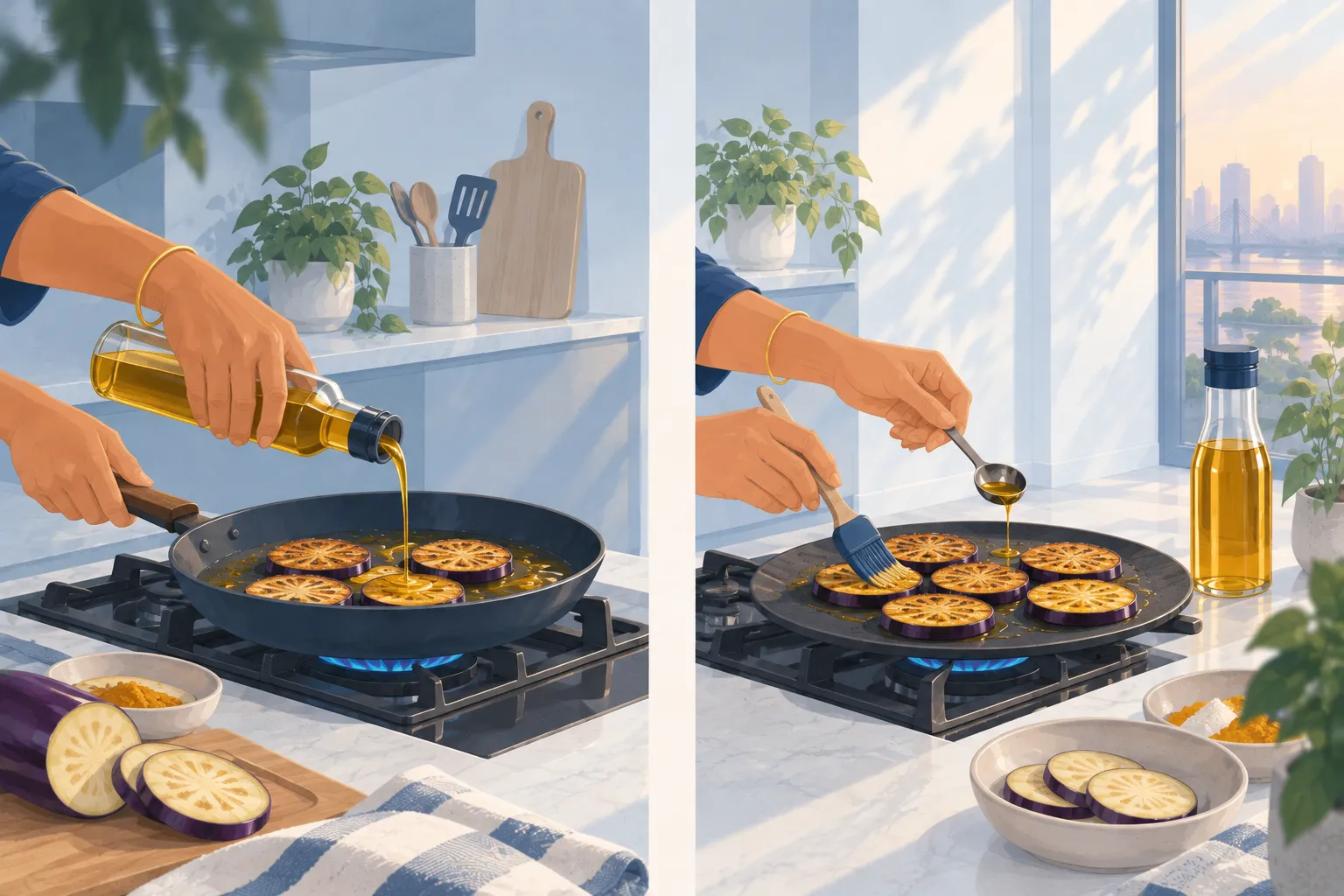
The usual wayShallow-fried in a generous pour of mustard oil
This wayBrowned on a tawa with one measured spoon
How to do it
- Rub the slices with haldi and salt, as always.
- Brush a flat tawa with one measured spoon of mustard oil.
- Lay the slices on, turn them once, and take them off when the edges brown.
Half the plate for shukto
For the person managing their weight, half the plate is shukto and any shaak (a dish of leafy greens) or other vegetable the kitchen has made that day. NIN sets that proportion for the whole day; here it is applied to dinner.[2]
The rest is rice, still the largest single portion, but a mound instead of a hill. Beside it sit a full bowl of masoor dal, a piece of fish with its jhol and potato, and 1 or 2 slices of bhaja from the tawa. The lime goes over the dal the way it does for everyone else.
- Half: shukto, and a shaak if there is one
- Most of the rest: rice, a mound instead of a hill
- The rest: masoor dal, fish with its jhol, 1 or 2 slices of bhaja
Around the newspaper
Most of these changes happen at the stove, before anyone sits down: the pour of oil for the bhaja, the size of the dal pot, which dish goes round again. They are the cook's decisions first.
The children may notice the bhaja tasting a little different; they will still fight over the last slice.
Dadu turns a page. The bhaja on his plate came off the tawa tonight, and he has not noticed.
If anyone at the table has diabetes, high blood pressure or kidney disease, their own doctor or dietitian may set different targets from the general guidelines here. Anyone who takes medicine for diabetes should check with their doctor before eating less rice at dinner.
To have a doctor look at your weight alongside the food your family eats, you can book a consultation.
No. Fish is one of the strengths of this dinner. The national dietary guidelines count fish among the flesh foods that supply good-quality protein, and the swaps here add to the fish and dal rather than take them away.
No. The national dietary guidelines' advice covers every cooking oil: use it in moderation, and do not fry again in oil that has already been used for frying. Measuring it by the spoon makes the moderation easier to see.
No. The potato stays in the jhol; the greens and other vegetables take most of the vegetable half of the plate.
Sources
- International Institute for Population Sciences (IIPS), ICF. National Family Health Survey (NFHS-5), 2019-21: India: Volume I. Mumbai: IIPS; 2021. Available from: dhsprogram.comCited atTable 10.27.1, p. 440Table 10.27.2, p. 441
- ICMR-NIN Expert Committee. Dietary Guidelines for Indians - 2024. Hyderabad: ICMR-National Institute of Nutrition; 2024. Available from: nin.res.inCited atp. 59p. 6p. 5p. 51pp. 54, 74p. 51p. 59p. 51p. 6
- Longvah T, Ananthan R, Bhaskarachary K, Venkaiah K. Indian Food Composition Tables 2017. Hyderabad: National Institute of Nutrition, Indian Council of Medical Research; 2017. Available from: nin.res.inCited atTables 1, 2, 4 and 5Table 1, pp. 4, 30Table 1, p. 8Table 4, p. xxiTable 4, p. xxi
- Anjana RM, Sudha V, Abirami K, Gayathri R, Manasa VS, et al. Dietary profiles and associated metabolic risk factors in India from the ICMR-INDIAB survey-21. Nat Med. 2025;31(11):3813-24. doi:10.1038/s41591-025-03949-4. PMID: 41028544. Available from: nature.comCited atExtended Data Tables 2 and 5
- National Sample Survey Office. Survey on Household Consumption Expenditure: 2022-23. New Delhi: Ministry of Statistics and Programme Implementation; 2024. NSS Report No. 591. Available from: mospi.gov.inCited atTable 3.8R, p. 34
- National Sample Survey Office. Household Consumption of Various Goods and Services in India, 2011-12. New Delhi: Ministry of Statistics and Programme Implementation; 2014 Jun. NSS Report No. 558 (68th round). Available from: mospi.gov.inCited atAppendix A, Table 1R, p. A-114; Table 1U, p. A-306