Masor tenga, greens and rice in a Guwahati home
A Guwahati weeknight of rice, masor tenga, aloo pitika and greens, read for its fish, its greens, the share of rice and the mustard oil drizzle.
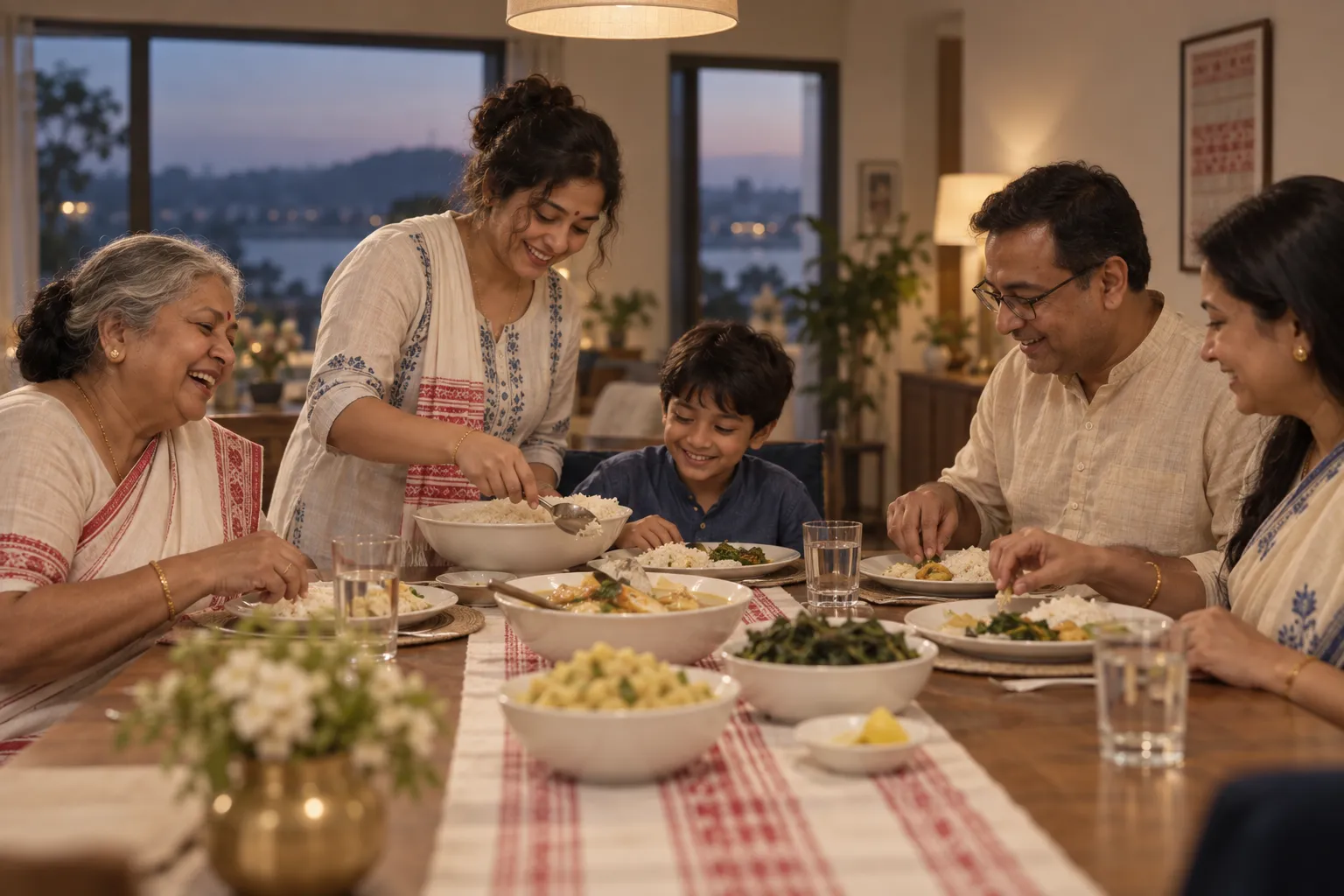
A slice of lemon sits at the edge of the plate, ready to be squeezed over the rice. Next to it, the masor tenga: fish in a thin, sour gravy. Then aloo pitika, potato mashed with onion and green chilli, and a dish of greens. At the head of the table the grandmother is mid-laugh, with her children and grandchildren eating the same meal around her.
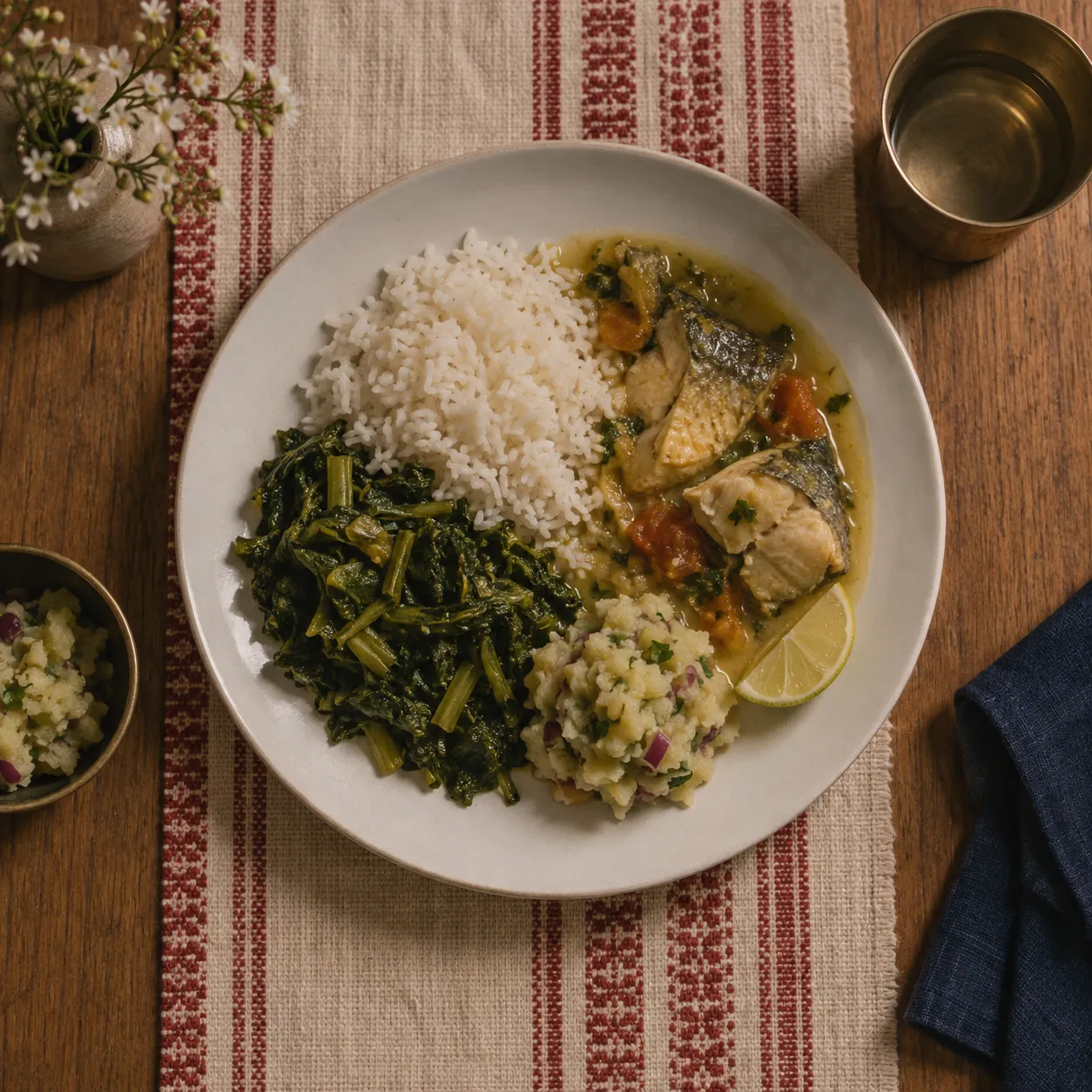
- Rice
- Greens a dish of greens
- Masor tenga fish in a thin, sour gravy
- Lemon to squeeze over the rice
- Aloo pitika potato, onion and green chilli
| Per 100 g raw | Energykcal | Proteing | Carbsg | Fatg | Fibreg |
|---|---|---|---|---|---|
| Rice, milled | 356 | 7.9 | 78.2 | 0.5 | 2.8 |
| Rohu | 102 | 19.7 | none | 2.4 | none |
| Amaranth leaves | 31 | 3.3 | 2.3 | 0.7 | 4.4 |
| Potato | 70 | 1.5 | 14.9 | 0.2 | 1.7 |
| Onion | 48 | 1.5 | 9.6 | 0.2 | 2.5 |
| Per 100 g raw | Ironmg | Folateµg | Zincmg | Calciummg | β-caroteneµg |
|---|---|---|---|---|---|
| Rice, milled | 0.7 | 9 | 1.2 | 7 | none |
| Rohu | 1.0 | none | 0.8 | 39 | none |
| Amaranth leaves | 4.6 | 70 | 0.9 | 330 | 8,553 |
| Potato | 0.6 | 16 | 0.3 | 10 | none |
| Onion | 0.4 | 29 | 0.4 | 21 | 1 |
Per 100 g of each raw ingredient, not a cooked helping. Bold marks the ingredient with the most of each micronutrient per 100 g raw. That is not what a served portion delivers. "none" means none is listed.
Values: Indian Food Composition Tables 2017.[2]
The tenga is the grandmother's, and its sour gravy stays hers. Fish and greens are already in these bowls on a school night in Guwahati. This post looks at the rice, the potato and the mustard oil on the pitika.
The fish and the greens
Fish is a familiar food in Assam.
of women aged 15 to 49 in Assam ate fish at least once a week (NFHS-5, 2019-20).[1]
of men aged 15 to 49 in Assam did the same.[1]
A tenga on a weeknight is ordinary here, and every change below keeps it.
Tenga is often made with rohu. The Indian Food Composition Tables list 19.7 g of protein per 100 g of raw rohu.[2] The tenga brings it to the table in a light, sour gravy.
The greens matter as much as the fish. ICMR-NIN's healthy-eating advice asks for non-starchy vegetables and green leafy vegetables in every meal, and in the same NFHS-5 survey, 86% of women and 91% of men aged 15 to 49 in Assam ate dark green leafy vegetables at least weekly.[3][1]
Rice, potato and a drizzle
Rice is the grain on this table.
2022-23 household consumption survey.[4]
The ICMR-INDIAB diet survey, which covered Assam between 2011 and 2017, found that refined cereals, which in the Northeast mostly means white rice, supplied more of the day's energy than the guidelines allow for all cereals together.
Share of the whole day's energy, adults in Assam (ICMR-INDIAB, 2011 to 2017); it covers every meal together.[5] NIN sets that line for all cereals and millets.[3]
Dinner is a meal where some of that rice space can go to greens.
Raw amaranth leaves, one of the greens many Assamese kitchens cook, have more than twice the fibre of raw potato.[2] So the pitika stays as a side, and the greens fill more of the plate.
The last piece is the oil. In NSS data from 2011-12, mustard oil was the main cooking oil in Assam's households.[6] A little raw mustard oil often goes into the pitika at the end. The pitika's drizzle counts towards the day's visible fat, the oil and ghee added in cooking, just as the oil in the pan does.
1 teaspoon is a level teaspoon, not heaped: about 5 g of oil, ghee or salt.
NIN's figures for sedentary adults, for the whole day. It counts 20 to 50 g of cooking fat as 4 to 10 teaspoons, and 5 g of salt as 1 teaspoon.[3]
Smaller pitika, fuller greens
- Greens as a full helping, pitika as a smaller one. The pitika keeps its onion and chilli; there is just less of it. The greens take most of the vegetable half, in line with NIN's advice to have greens in every meal.[3]
- More vegetable in the tenga pot. The tenga often has tomato or another vegetable in it already. The fish stays at its usual share, and the rice mound gives up the space the vegetables take. NIN's plate gives about half its space to vegetables, greens, fruit, roots and tubers.[3]
- Mustard oil for the pitika from a teaspoon. The raw, pungent finish stays. A teaspoon kept beside the bottle means each drizzle is the same measured amount, and it counts towards the day's visible fat.
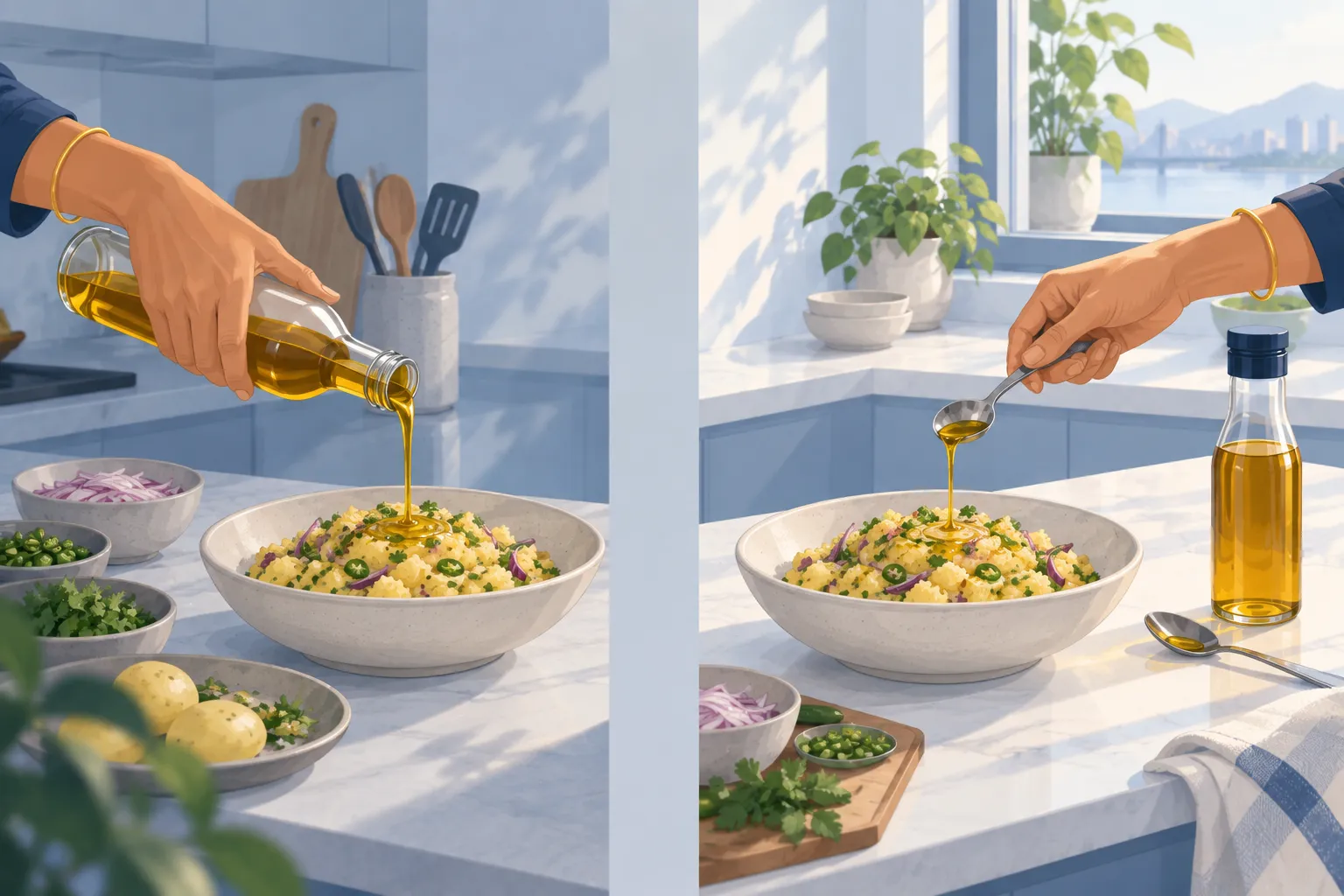
The usual wayMustard oil poured straight from the bottle
This wayOne teaspoon, the same every time
How to do it
- Keep a teaspoon beside the mustard-oil bottle.
- Drizzle one teaspoon over the pitika at the end.
- Keep the onion, the chilli and the raw, pungent finish.
A teaspoon is about 5 g of oil, and each one counts towards the day's visible fat.[3]
One person's plate, same tenga
For whoever is managing their weight, half the plate goes to the greens and the tenga's vegetables, roughly the share ICMR-NIN's plate gives to vegetables, greens, fruit, roots and tubers.[3] That plate describes a full day of eating; here its proportions are applied to dinner alone.
Rice takes the next largest share, and fish with its tenga sits beside it, with a helping of pitika and a squeeze of lemon over everything. The sourness of the tenga, the chilli in the pitika and the sharp lemon all stay on this plate.
- Half: the greens and the tenga's vegetables
- Most of the rest: rice, the next largest share
- The rest: fish with its tenga, and a helping of pitika
A squeeze of lemon goes over everything.
The grandmother's tenga
The grandmother may have cooked tenga the same way for decades. The recipe stays hers; the only change to the pot is a little more vegetable. Whoever does the cooking, the only new things in the kitchen are a teaspoon beside the mustard oil bottle and perhaps a bigger bunch of greens from the market.
At the head of the table the grandmother is still laughing, the lemon still goes over the rice, and the bowl of greens comes back for a second helping.
If anyone at the table has diabetes, high blood pressure or kidney disease, their own doctor or dietitian may set different targets from the general guidelines here. Anyone who takes medicine for diabetes should check with their doctor before eating less rice at dinner.
To have a doctor look at the whole picture, tenga and greens included, you can book a consultation.
For weight, the amount is what adds up. Every oil and ghee carries the same energy per gram of fat, so a measured teaspoon of mustard oil keeps the flavour and keeps count of it.
No. Aloo pitika can stay as a side dish, with a full helping of greens filling the vegetable half of the plate.
If anyone at the table has diabetes, high blood pressure or kidney disease, their own doctor or dietitian may set different targets from the general guidelines here. Anyone who takes medicine for diabetes should check with their doctor before eating less rice at dinner.
Sources
- International Institute for Population Sciences (IIPS), ICF. National Family Health Survey (NFHS-5), 2019-21: India: Volume I. Mumbai: IIPS; 2021. Available from: dhsprogram.comCited atTable 10.27.1, p. 440Table 10.27.2, p. 441Tables 10.27.1 and 10.27.2, pp. 440-1
- Longvah T, Ananthan R, Bhaskarachary K, Venkaiah K. Indian Food Composition Tables 2017. Hyderabad: National Institute of Nutrition, Indian Council of Medical Research; 2017. Available from: nin.res.inCited atTables 1, 2, 4 and 5Table 1, p. 30Table 1, pp. 5, 14
- ICMR-NIN Expert Committee. Dietary Guidelines for Indians - 2024. Hyderabad: ICMR-National Institute of Nutrition; 2024. Available from: nin.res.inCited atp. 1p. 5pp. 54, 74p. 1p. 6p. 54p. 6
- National Sample Survey Office. Survey on Household Consumption Expenditure: 2022-23. New Delhi: Ministry of Statistics and Programme Implementation; 2024. NSS Report No. 591. Available from: mospi.gov.inCited atTable 3.8R, p. 34
- Anjana RM, Sudha V, Abirami K, Gayathri R, Manasa VS, et al. Dietary profiles and associated metabolic risk factors in India from the ICMR-INDIAB survey-21. Nat Med. 2025;31(11):3813-24. doi:10.1038/s41591-025-03949-4. PMID: 41028544. Available from: nature.comCited atExtended Data Table 3
- National Sample Survey Office. Household Consumption of Various Goods and Services in India, 2011-12. New Delhi: Ministry of Statistics and Programme Implementation; 2014 Jun. NSS Report No. 558 (68th round). Available from: mospi.gov.inCited atAppendix A, Table 1R, p. A-10; Table 1U, p. A-202