Getting omega-3 from Indian food
Oily sea fish such as mackerel and sardines carry high amounts of EPA and DHA (the omega-3s in fish). A family that eats no fish can still get plant omega-3 from nuts, seeds, soybean, pulses and greens.
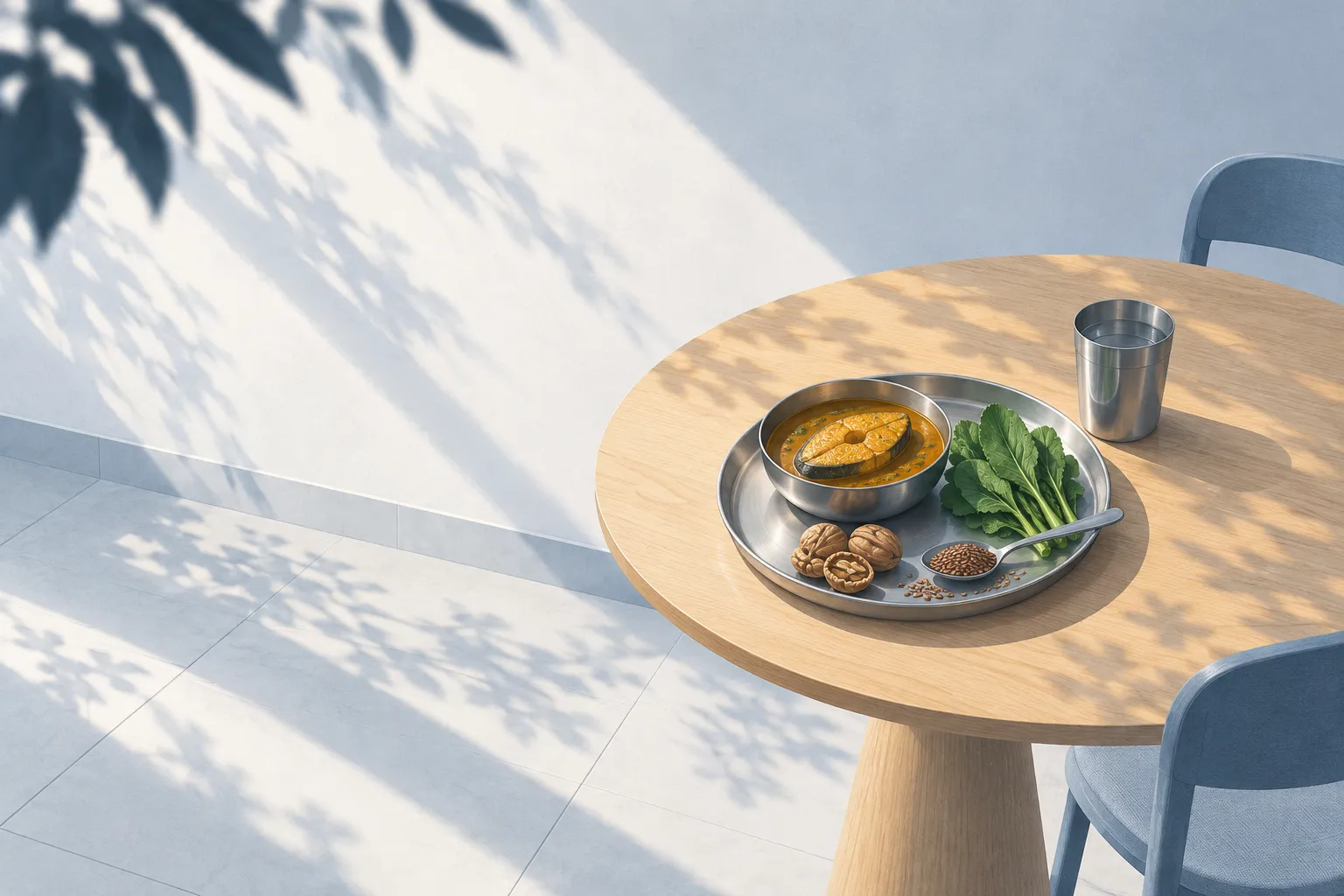
Tonight the steel thali has fish curry, walnuts, flaxseed and greens. Your sister eats no fish, so she moves the curry to one side.
Which foods on this thali give omega-3? And what can someone who eats no fish eat instead?
Omega-3 in oily sea fish
ICMR-NIN is India's National Institute of Nutrition. It lists marine fish, other seafood and eggs as sources of EPA and DHA.[1]
Oily fish carry high amounts. Fish with less fat, and shellfish, carry less.[2]
ICMR-NIN's food table calls fish with more than 5% fat oily fish. Its examples include seer (surmai or vanjaram), mackerel (bangda or ayala), sardines (mathi or tarli), salmon and eel.[3]
About 10 g of oily fish gives 0.1 g of EPA, DHA and a related fat, DPA.[3]
For the same amount, you need 20 to 50 g of low or medium fat fish.[3]
The same table warns that the amount varies with the kind of fish, the season, what the fish ate, packing and cooking.[3] Treat the figures as a rough guide. ICMR-NIN's dietary guidelines also note that air-frying fish may lower the omega-3 in it.[1]
How much fish to eat in a week
ICMR-NIN's 2024 dietary guidelines suggest about 200 g of marine fish a week. The examples they name are salmon, mackerel, trout and tuna.[1] The institute's 2020 report gives about 250 g of fatty marine fish a week.[3] Our article on how much omega-3 adults need sets the 2 figures side by side.
If you are pregnant, see omega-3 in pregnancy first.
Omega-3 for a home that eats no fish
ICMR-NIN's first advice for people who eat no fish is to eat more plant omega-3 (ALA).[3] Its dietary guidelines name walnuts (akhrot), flaxseed (alsi), chia seeds, soybean, fenugreek seeds (methi), mustard (sarson) and leafy vegetables. Pulses and beans carry some too.[1]
The chart shows how many grams of each food give 0.1 g of plant omega-3. Fewer grams means a richer source.[3]
Source: ICMR-NIN 2020, Table 6.6
ICMR-NIN puts the minimum for all omega-3 at about 2.2 g a day on a 2,000-calorie diet, a figure for the population.[1] It says enough nuts, oilseeds, pulses and beans in a balanced diet meet it.[1]
These foods give ALA. ICMR-NIN does not list them as sources of EPA or DHA.
Among common Indian oils, flaxseed, mustard and soybean oil carry plant omega-3.[3] Our article on omega-3, 6 and 9 compares the oils in your kitchen.
For a home that eats eggs, the food table gives 2 to 3 standard eggs for 0.1 g of EPA, DHA and DPA.[3]
For EPA and DHA without fish, ICMR-NIN names tiny sea algae (marine microalgae) as a vegetarian source. Its food table lists algal oil DHA products, and tells readers to check the label for the amount.[3] An algal oil supplement is one way to get DHA, and sometimes EPA, without fish.[2]
If you are thinking about a supplement, our omega-3 guide explains the kinds and how to compare them.
| Kind of omega-3 | Amount that gives 0.1 g | |
|---|---|---|
| Oily sea fish | EPA, DHA and DPA | About 10 g |
| Low or medium fat fish | EPA, DHA and DPA | 20 to 50 g |
| Eggs | EPA, DHA and DPA | 2 to 3 standard eggs |
| Nuts, seeds, pulses and greens | Plant omega-3 (ALA), not EPA or DHA | 2 g (walnuts) to 60 g (greens, other pulses) |
| Algal oil | DHA, and sometimes EPA | Check the label for the amount |
Sources: ICMR-NIN; NIH
3 food changes that add omega-3 to your week
- Oily fish on fish day. Swap a low or medium fat fish for mackerel, sardine or seer. About 10 g of these gives what 20 to 50 g of the leaner fish gives.[3]
- Rajmah, black gram or cowpea on a vegetarian day. On some vegetarian days, cook one of these in place of another pulse. About 20 g of these pulses gives as much plant omega-3 as about 60 g of other pulses.[3]
- Methi seeds in the tadka. Add fenugreek (methi) seeds when you temper the dal. About 5 g of the seeds gives 0.1 g of plant omega-3.[3]
How can you get omega-3 from Indian food? If your home eats fish, choose oily sea fish such as mackerel, sardines or seer.[3] Without fish, walnuts, flaxseed, soybean, fenugreek and mustard seeds, pulses and greens give plant omega-3 (ALA), not EPA or DHA.[1]
Ask your doctor before you take an omega-3 supplement if you take a blood thinner or any medicine regularly, are pregnant or breastfeeding, or are buying it for a child.
Do not take more than the pack says.
Medical disclaimer: This article is general information. It does not replace advice from your doctor about your own health.
Common questions
Oily sea fish. ICMR-NIN's examples include seer (surmai), mackerel (bangda), sardines (mathi), salmon and eel. The amount in any fish varies with the kind, the season and how it is cooked.
Walnuts, flaxseed, chia seeds, soybean, fenugreek seeds, mustard, pulses, beans and green leafy vegetables give plant omega-3 (ALA). Eggs also give some EPA and DHA.
ICMR-NIN's food table says the amount varies with cooking. Its dietary guidelines note that air-frying fish may lower the omega-3 in it.
Sources
- ICMR-NIN Expert Committee. Dietary Guidelines for Indians - 2024. Hyderabad: ICMR-National Institute of Nutrition; 2024. Available from: nin.res.inCited atp. 53, Guideline 7p. 86p. 56, Guideline 7p. 53, Guideline 7p. 54, Guideline 7p. 54, Guideline 7p. 53, Guideline 7
- National Institutes of Health, Office of Dietary Supplements. Omega-3 fatty acids: fact sheet for health professionals [Internet]. National Institutes of Health; 2025 Aug 22 [cited 2026 Oct 23]. Available from: ods.od.nih.govCited atIntroduction; Sources of omega-3s, FoodSources of omega-3s, Dietary supplements
- ICMR-National Institute of Nutrition. Nutrient requirements for Indians: recommended dietary allowances and estimated average requirements, 2020. A report of the expert group. Hyderabad: ICMR-NIN; 2020. Updated 2024. Available from: nin.res.inCited atp. 116, Table 6.6p. 116, Table 6.6p. 116, Table 6.6p. 116, Table 6.6p. 21, Table A4, footnotep. 115p. 116, Table 6.6p. 112, Table 6.2p. 116, Table 6.6pp. 115 to 116, Tables 6.5 and 6.6p. 116, Table 6.6p. 116, Table 6.6p. 116, Table 6.6p. 116, Table 6.6