How much protein, fat and carbs do I need each day?
Find the calories you need to maintain your weight, and your protein, fat and carbs, using the method of India's National Institute of Nutrition.
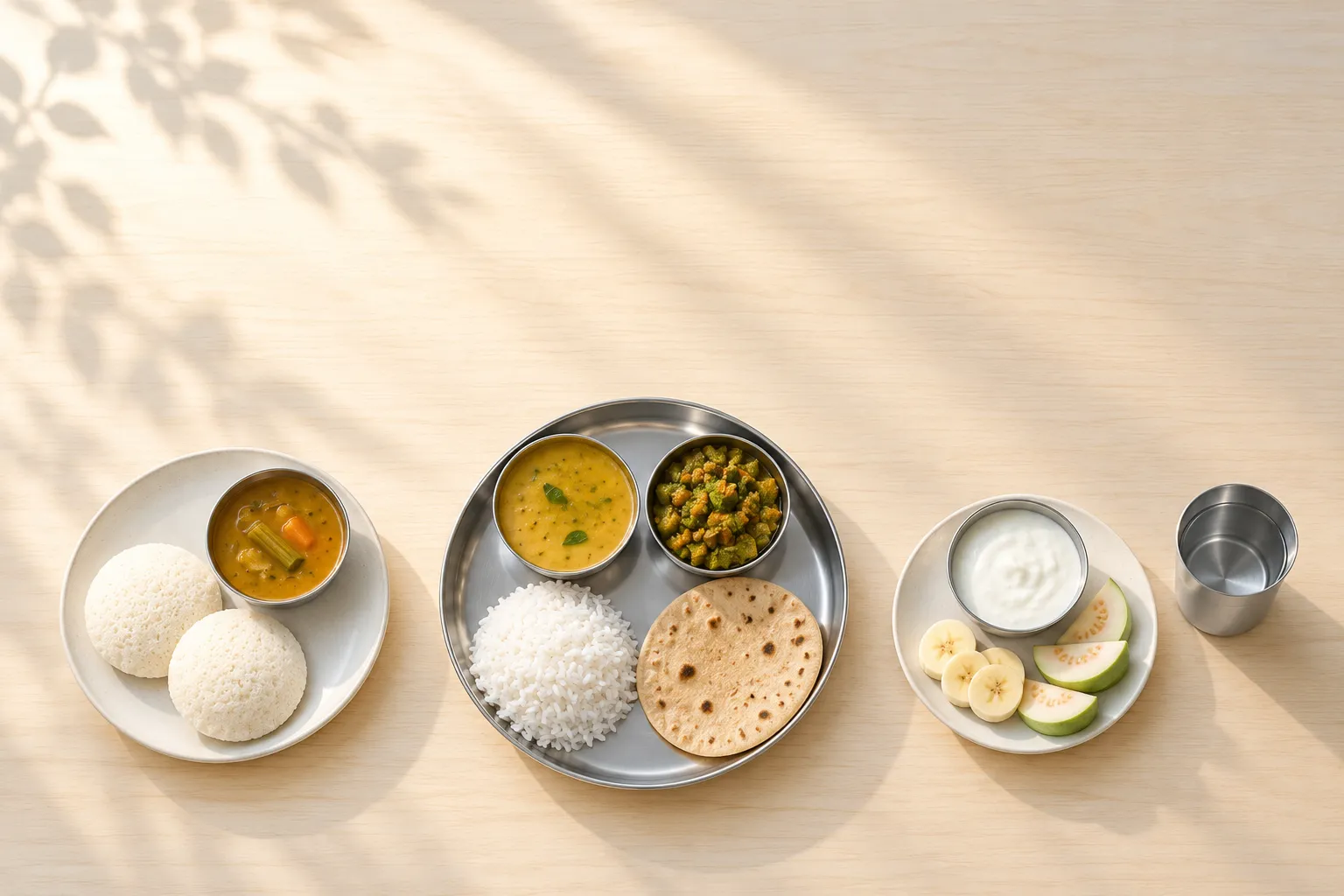
How active is your day?
Choose the level that matches what you do for most of the day.
| Level | Choose it if |
|---|---|
| Sedentary | You sit for most of the day, at a desk or doing housework |
| Moderate | You are on your feet and walking for most of the day, or you exercise for about an hour every day |
| Heavy | You do hard manual work most days, such as farm work or carrying loads |
- Housework: counts as sedentary. NIN's 2024 guidelines put cleaning the house and cooking there.[6]
- 30 minutes of exercise a day: raises your level only a little, so choose sedentary.[2]
- About an hour of exercise every day: brings you close to moderate.[3]
- A daily walk: already counted. Each level includes an hour of walking.[2]
- Gym and sports: do not count as heavy. Heavy means hard manual work for most of the day.[2]
What your numbers mean
Each number is a daily total for all the food you eat.
- Calories: eat about this much, and your weight stays about where it is. Your own needs can be higher or lower.
- Protein, fat, carbohydrate and fibre: grams of each nutrient in your food. This is not the weight of the food itself.
- Added sugar: sugar in tea, sweets and cooking. Keep it under the number shown. One teaspoon is 5 g.[6]
- Cooking oil and ghee: oil and ghee used to cook your food. Keep it under the number shown.[6]
An example
A 40-year-old woman who weighs 65 kg and spends most of her day at home uses about 1,750 kcal a day to maintain her weight.[1]
| Daily estimate | At home (sedentary) | On her feet (moderate) |
|---|---|---|
| Energy | 1,750 kcal | 2,250 kcal |
| Protein | 54 g | 54 g |
| Fat | 39 to 58 g | 50 to 75 g |
| Carbohydrate | 219 to 263 g | 281 to 338 g |
| Fibre | About 26 g | About 34 g |
| Added sugar | Under 22 g, about 4 teaspoons | Under 28 g, about 6 teaspoons |
| Cooking oil and ghee | Up to 20 g, about 4 teaspoons | Up to 30 g, about 6 teaspoons |
NIN's table gives the energy. The other rows are the calculator's figures for her.
She is 155 cm tall, so her BMI is 27. Her result says the number is only a rough guide.
What to do next
The calculator does not set a lower number for weight loss. A doctor or dietitian can set one, and check that you still get enough protein and other nutrients.
Check with your doctor first
- BMI 23 or above: the number is only a rough guide. NIN says its energy tables do not suit people above a healthy weight.[1] Ask a doctor or dietitian to set your figure.
- Diabetes medicine: Anyone who takes medicine for diabetes should check with their doctor before changing how much rice or roti they eat.
- Kidney disease: If you have kidney disease or have been told to limit protein, ask your doctor how much protein is right for you.
- Worried about food or weight: if counting calories makes you anxious, or you often skip meals to control your weight, talk to a doctor.
When the calculator shows no number
It shows no estimate for anyone under 18, in pregnancy or breastfeeding, or with a BMI below 18.5.
- Under 18: ask a doctor or dietitian about a child's or teenager's needs.
- Pregnancy and breastfeeding: NIN adds these extra calories a day.[1][2] Your doctor or dietitian can tell you what applies to you.
- Second and third trimesters: 350 kcal
- Breastfeeding, first 6 months: 600 kcal
- Breastfeeding, 7 to 12 months: 520 kcal
- BMI below 18.5: a doctor or dietitian can check what you need.
How the numbers are worked out
Energy at rest
The calculator starts with your basal metabolic rate (BMR): the energy your body uses at rest. It uses the equations of the Food and Agriculture Organization, the World Health Organization and the United Nations University (FAO/WHO/UNU, 2004). They need only your sex, age and weight.[3]
NIN found that these equations overestimate BMR in Indians by 10% to 12%.[2] NIN suggests a reason, which it has not proved. Indians may carry relatively more fat and less muscle.[1]
So NIN lowers the result by 10% for men and by 9% for women.[2] The calculator does the same, with the equations as NIN prints them.[1]
Activity level
The calculator multiplies your BMR by a number for how active your day is. NIN calls this the physical activity level.
=Daily energy kcal a day
NIN uses 1.40 for sedentary, 1.80 for moderate and 2.30 for heavy work.[2] It lowered the sedentary level from 1.53 to 1.40 in 2020, after recalculating it from Indian studies.[2]
Checking against NIN's tables
For a man aged 18 to 30 who weighs 65 kg and works at a desk, NIN's weight table gives 2,109 kcal a day.[1]
For a woman of the same age and work who weighs 55 kg, NIN's table gives 1,657 kcal a day.[1]
The calculator gives the same answers, rounded to the nearest 10 kcal: 2,110 and 1,660.
BMR falls with age, by nearly 200 kcal a day after 60.[2] NIN's estimate for a desk-working man over 60 who weighs 65 kg is 1,700 kcal a day.[2]
Why we do not use the US equations
The US Department of Agriculture's DRI calculator asks for the same details: sex, age, height, weight and activity. It works from the US Dietary Reference Intakes, set by the US National Academies.[4]
The US updated its energy equations in 2023. 78.1% of the data behind them came from studies in the United States. Race and ethnicity were not part of the analysis.[5]
For one person, the US estimate has a typical error of about 340 kcal a day for men and 240 kcal for women, at the average size of the people studied.[5] NIN publishes no error figure for its method, so treat any single number as an estimate.
Protein, fat, carbohydrate, fibre and sugar
NIN gives these ranges for adults, as shares of the day's energy:[1]
- Fat: 20% to 30%. The calculator turns this into grams at 9 kcal a gram.[2]
- Carbohydrate: 50% to 60%, at 4 kcal a gram.
NIN's documents do not agree on the top of the carbohydrate range. The full report prints 50% to 55%.[2] We use the later summary's 50% to 60%.[1]
Protein uses our protein calculator's figure: 0.83 g for every kg you weigh, India's allowance for healthy adults.[1] At a BMI of 30 or above, it uses a range from an adjusted weight. Over 65, it also shows the higher range some expert groups suggest. How the protein calculator works explains that range and the other cases.
- Fibre: about 15 g for every 1,000 kcal.[1]
- Added sugar: less than 5% of the day's energy.[1] NIN's 2024 guidelines also give gram limits that differ from page to page; we use the share of energy.
- Cooking oil and ghee: NIN's 2024 guidelines set 20, 30 and 40 g a day for women, and 30, 40 and 50 g for men, by activity.[6]
Above a healthy weight
NIN built its energy tables for adults with a healthy BMI of 18.5 to 23. It says they are not suitable for people who are underweight or overweight.[1]
NIN's weight tables cover men from 50 to 81 kg and women from 45 to 73 kg, with no heavy-work column. For weights outside those ranges, the calculator uses NIN's method to estimate the result.[1]
All the figures in one place
| Step | Figure | Source |
|---|---|---|
| Energy at rest | FAO/WHO/UNU equation, lowered 10% for men and 9% for women | FAO/WHO/UNU 2004; ICMR-NIN 2020 |
| Activity level | 1.40 sedentary, 1.80 moderate, 2.30 heavy | ICMR-NIN 2020 |
| Protein | 0.83 g per kg for most healthy adults | ICMR-NIN 2020 |
| Fat | 20% to 30% of energy | ICMR-NIN 2020 (revised 2024) |
| Carbohydrate | 50% to 60% of energy | ICMR-NIN 2020 (revised 2024) |
| Fibre | About 15 g per 1,000 kcal | ICMR-NIN 2020 (revised 2024) |
| Added sugar | Less than 5% of energy | ICMR-NIN 2020 (revised 2024) |
| Cooking oil and ghee | Women 20 to 40 g, men 30 to 50 g, by activity; 1 teaspoon is 5 g | ICMR-NIN 2024 |
| Under 18, pregnancy, breastfeeding, BMI below 18.5 | No number; see a doctor or dietitian | KiloCare's choice |
Your data and privacy
Nothing is saved unless you press Save.
- In your browser: the calculator works out your estimate there. Your answers stay in your browser unless you press Save.
- Save: if you are signed in and press Save, your account keeps your gender, age, weight, height, activity level, whether you limit protein, and the result. This is separate from your medical record.
- Delete: you can delete your saved results any time from the calculator's result screen.
- Signed in: the calculator fills in your saved age, weight, height and gender. Your account does not change. If you type something else, the calculator uses that.
If something looks wrong
Write to contact@kilocare.in and tell us which part. We check it against the source, correct this page and update its date.
Sources
- ICMR-National Institute of Nutrition. Short summary report of nutrient requirements for Indians: recommended dietary allowances (RDA) and estimated average requirements (EAR). Hyderabad: ICMR-NIN; 2020. Updated 2024. Available from: nin.res.inCited atp. 8, Table 3p. 5p. 6, Table 1p. 5p. 9, Table 5p. 7, Table 2p. 8, Table 3p. 31, A4p. 31, A4p. 10, Protein requirementsp. 13p. 33, A7p. 5pp. 7 to 8, Tables 2 and 3
- ICMR-National Institute of Nutrition. Nutrient requirements for Indians: recommended dietary allowances and estimated average requirements, 2020. A report of the expert group. Hyderabad: ICMR-NIN; 2020. Updated 2024. Available from: nin.res.inCited atp. 61p. 44, Table 4.12p. 44, Table 4.12p. 48p. 41p. 42, section 4.5 and Table 4.10p. 43, Table 4.11p. 43p. 43p. 306p. 60p. 21, A4
- Food and Agriculture Organization of the United Nations, World Health Organization, United Nations University. Human energy requirements: report of a joint FAO/WHO/UNU Expert Consultation, Rome, 17-24 October 2001. Rome: FAO; 2004. FAO Food and Nutrition Technical Report Series 1. Available from: fao.orgCited atsection 5.3.2Table 5.2
- National Agricultural Library, US Department of Agriculture. DRI Calculator for Healthcare Professionals [Internet]. USDA National Agricultural Library; [cited 2026 Oct 19]. Available from: nal.usda.govCited at
- National Academies of Sciences, Engineering, and Medicine. Dietary Reference Intakes for Energy. Washington (DC): The National Academies Press; 2023. doi:10.17226/26818. Available from: nationalacademies.orgCited atchapter 5chapter 5, Table 5-8
- ICMR-NIN Expert Committee. Dietary Guidelines for Indians - 2024. Hyderabad: ICMR-National Institute of Nutrition; 2024. Available from: nin.res.inCited atp. 70, Guideline 10p. 111, Annexure Ip. 54p. 54